
Most industrial valve RFQs do not break because the supplier cannot identify the valve family. They break because the buyer leaves too much engineering meaning inside too few words.
A request says ball valve or gate valve, adds size and pressure class, and then expects quotations to be directly comparable. In reality, the supplier still has to guess seat logic, shutoff expectation, emissions scope, testing basis, document package, and delivery assumptions. That is where commercial comparison starts to drift.
The 2026 public signal is simple: buyers can no longer treat those gaps as harmless.
API has refreshed or reconfirmed several valve-family standards, and the International Energy Agency is still warning that methane pressure is not fading. For sourcing teams, that does not mean every RFQ should become a standards digest. It means the RFQ should be clearer before the first quotation round.
Why This Matters More in 2026
The API Standards Plan is a useful buyer-side signal because it shows which valve references are current again.
On the same public page, API lists API Std 609 dated 2026-05-18, API RP 591 dated 2026-02-12, API Std 608 dated 2025-04-02, API Std 599 dated 2025-10-10, API Std 603 dated 2025-07-22, and API Std 594 dated 2022-02-10.
That list is not a quoting shortcut by itself. But it is a clear reminder that buyers are still working inside differentiated valve families, not one interchangeable product bucket called industrial valve.
The IEA adds the commercial pressure behind that reminder. In its Global Methane Tracker 2026, the agency says there is no sign global energy-related methane emissions fell in 2025 and notes growing momentum toward import standards for methane intensity in fuels. That matters because more projects are now treating leakage discipline, qualification logic, and documentation as sourcing issues, not just inspection issues at the end.
For production acceptance and emissions-focused language, ISO 15848-2 remains a relevant reference point when fugitive emissions are part of the package. The point is not to overload the RFQ. The point is to stop hiding buyer expectations behind generic valve labels.
The Real RFQ Problem
Many buyers still ask six different valve families with the same commercial grammar: valve type, size, pressure class, and quantity. That is enough to start a conversation. It is often not enough to compare quotations fairly.
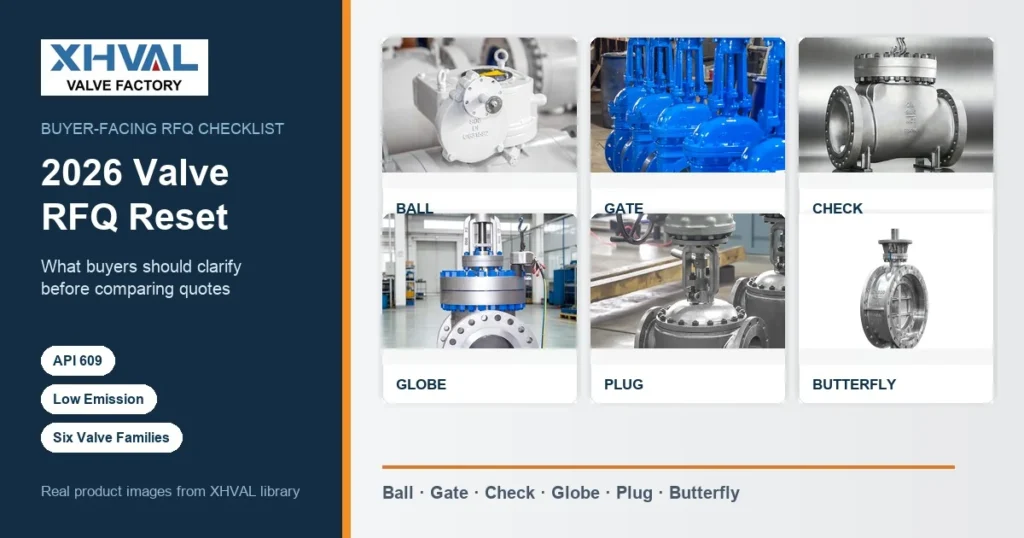
The same NPS 8 Class 300 valve request means very different quotation work once the valve family changes. A ball valve quote may turn on bore, fire-safe basis, anti-static details, and seat selection. A gate valve quote may turn on material route, corrosion basis, bonnet construction, and inspection scope. A check valve quote may turn on slam risk, orientation, cracking behavior, and face-to-face preference. A globe valve quote may turn on throttling duty, trim path, pressure drop, and cycle expectation. A plug valve quote may turn on sleeved versus metal-seated route, torque expectation, and maintenance philosophy. A butterfly valve quote may turn on concentric versus double eccentric versus triple eccentric, plus shutoff and emissions expectations.
If the buyer leaves those decisions implicit, suppliers will fill the gaps differently. The quotation looks fast, but the comparison becomes slow.
A 2026 RFQ Reset for Six Valve Families
Ball valves: if the RFQ only says ball valve, suppliers still have to infer full-port or reduced-port logic, seat route, operating mode, and test assumptions. API Std 608 staying current is a reminder that ball-valve comparison still depends on more than nominal size and pressure class.
Gate valves: gate valve buying often looks straightforward until corrosion basis, trim path, or inspection scope enters the job. API’s current public plan still points buyers toward differentiated gate references such as API Std 603 and the related small-size API Std 602 family context.
Check valves: API Std 594 remains a useful public anchor because it reminds buyers that face-to-face style, installation orientation, flow stability, and closure behavior still change the commercial answer.
Globe valves: when the valve is closer to control or repeated adjustment duty, the RFQ should say so. Otherwise, suppliers may quote on different assumptions about trim wear, shutoff basis, and operating pattern.
Plug valves: API Std 599 being current again is useful because plug-valve RFQs still tend to collapse multiple product routes into one label.
Butterfly valves: this is where the 2026 signal is strongest because API Std 609 was updated on 2026-05-18. A butterfly valve RFQ should usually make the design path visible: concentric, double eccentric, or triple eccentric. If the application points toward a broader starting point, buyers can review our butterfly valve range. If the duty clearly moves toward higher temperature, metal seating, or more severe shutoff conditions, our triple eccentric butterfly valve range is the more relevant reference path. For high-performance soft-seated service, a double eccentric butterfly valve reference is often the clearer commercial lane.
Where Methane Pressure Changes Buyer Behavior
The IEA’s methane findings do not rewrite valve standards. They do change buyer attention.
When emissions pressure stays high, more RFQs start asking questions that used to be delayed: what is the leakage expectation, what qualification basis is expected, what documents must be submitted with the quote, and what deviations must be declared early.
This is where API RP 591 and emissions-focused references such as ISO 15848-2 become commercially useful. They remind buyers that qualification, leakage language, and document scope should be part of supplier comparison when the project risk justifies it.
The Eight RFQ Fields Buyers Should Add Before the Next Quote Round
- Valve family and design route
- Service basis: isolation, throttling, or repeated cycling
- Media and operating temperature
- Pressure class and connection details
- Shutoff or leakage expectation
- Emissions or qualification expectation, if applicable
- Required document package
- Declared deviations and delivery expectation
If most of those fields are still missing, the RFQ is probably too short for a fair quotation comparison.
What Buyers Should Do Next
Do not respond to 2026 by copying more standard numbers into every inquiry. Respond by removing hidden assumptions.
If a project is straightforward, keep the RFQ lean. If emissions scope, qualification logic, severe service, or document discipline will affect supplier selection, say so before suppliers quote against different internal interpretations. That is the real 2026 reset: not more words, but better-defined words.
FAQ Draft
Do buyers need to cite API standard numbers in every RFQ?
No. The practical benefit is not the citation itself. The benefit is using the latest public standards visibility to ask clearer design and scope questions before comparing quotations.
Is methane pressure only relevant for butterfly valves?
No. Butterfly valves are an easy example because API Std 609 is newly updated, but emissions pressure can affect buyer expectations across multiple valve families when leakage, qualification, and document control matter.
Why include xhvalbutterfly.com links in a broad XHVAL article?
Because the butterfly section has its own product-intent traffic and deserves a more specific internal path than a generic corporate page.