
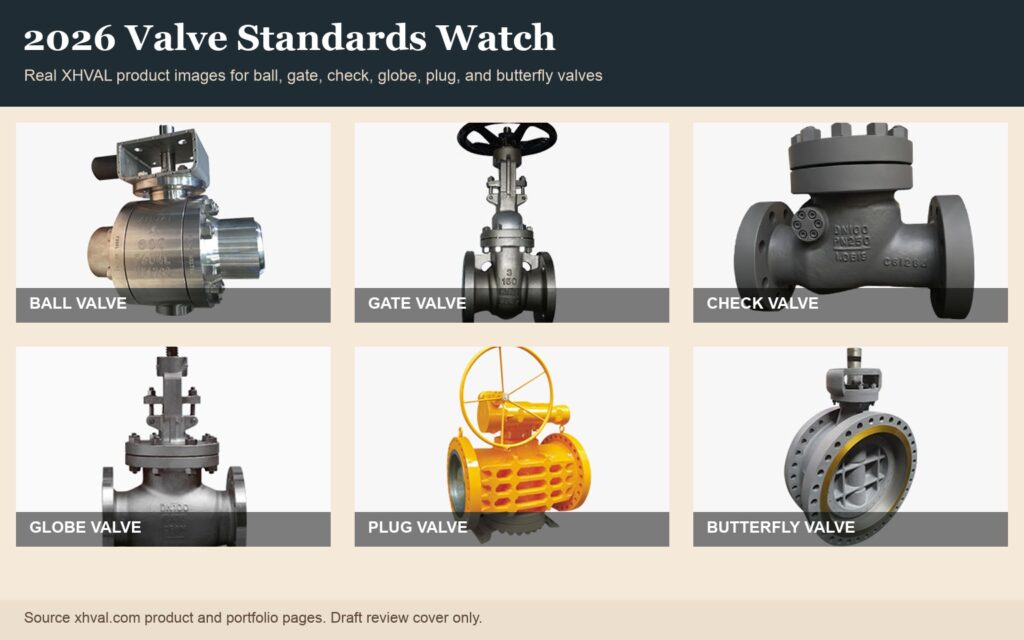
Industrial valve buyers do not need a new standards list every week.
They do need to notice when several public signals line up at the same time.
That is what is happening now.
In the current public record, API Std 609 for butterfly valves shows a tenth edition dated 2026-05-18. API’s public plan also shows current editions for API Std 608, API Std 599, API Std 603, API Std 594, and API RP 591. MSS has refreshed SP-126-2025 for in-line spring-assisted check valves, announced revised SP-78-2026 for gray iron plug valves, and lists SP-147-2025 for steel casting quality in standard class steel valves. ISO now shows ISO/AWI 15848-2 edition 3 as under development to replace the 2015 version. The IEA’s Global Methane Tracker 2026 adds commercial pressure by saying there was no sign global energy-related methane emissions fell in 2025.
None of that means every RFQ should become a standards memo.
It does mean buyers should stop sending short valve inquiries that hide the real engineering and commercial scope.
Why This Standards Watch Matters to Buyers
Most RFQ friction still comes from missing assumptions, not from missing product names.
A buyer writes ball valve, gate valve, check valve, globe valve, plug valve, or butterfly valve, adds size and pressure class, and expects fast quotation comparison. The supplier then has to guess what the buyer actually means by shutoff, duty cycle, casting route, emissions risk, testing basis, and document package.
That guesswork is exactly what slows quote comparison and creates avoidable clarification loops.
1. Butterfly valves: define the design path early
The clearest recent signal is API Std 609 tenth edition dated 2026-05-18.
For buyers, the practical lesson is not to paste API Std 609 into every butterfly valve inquiry. The lesson is to stop treating butterfly valve as one design answer.
If the application already points in a specific direction, the RFQ should say so:
- concentric
- double eccentric
- triple eccentric
If your team needs a broad product reference first, review our butterfly valve product range. If the project is moving toward higher temperature, metal seating, or severe-service isolation, our triple eccentric butterfly valve range is the more relevant path. For high-performance soft-seated service, a double eccentric butterfly valve reference usually gives a clearer buyer starting point.
2. Check valves: do not treat non-return duty as self-explanatory
API’s public plan shows API Std 594 ninth edition dated 2022-02-10, while MSS SP-126-2025 specifically covers in-line, spring-assisted, center-guided check valves for clean-fluid service and highlights both horizontal and vertical piping use.
That matters because many check-valve RFQs still say only check valve and leave the supplier to infer installation orientation, slam sensitivity, spring-assisted versus other closure behavior, pressure-drop sensitivity, and clean-fluid versus solids-bearing service.
3. Plug valves: specify the service lane, not only the valve family
API’s plan shows API Std 599 ninth edition dated 2025-10-10, and MSS announced revised SP-78-2026 for gray iron plug valves on 2026-05-11, describing general-purpose service with flanged or threaded ends.
The buyer takeaway is practical: the label plug valve is still too broad if the project already knows whether it is buying a basic utility route or a more demanding service case.
4. Ball, gate, globe, and check packages: add casting and document discipline sooner
MSS SP-147-2025 is useful because it turns attention back to a quiet but important issue: the quality standard for steel castings used in standard class steel valves. For XHVAL product families, that matters across broad package sourcing for ball valves, gate valves, globe valves, and check valves.
API’s public plan also keeps related category references visible through API Std 608, API Std 603, and API Std 594. If the project will evaluate quotations partly on casting consistency, inspection discipline, traceability, or documentation completeness, those expectations should be visible before suppliers quote.
5. Emissions-sensitive projects: set acceptance language before commercial comparison
The IEA’s Global Methane Tracker 2026 says there was no sign global energy-related methane emissions fell in 2025. API’s public plan also shows API RP 591 seventh edition dated 2026-02-12, while ISO now lists ISO/AWI 15848-2 edition 3 as under development and says it will replace ISO 15848-2:2015.
This does not mean every industrial valve inquiry now requires fugitive-emissions testing language. It does mean buyers should identify earlier when the package is likely to be judged on leakage expectations, production acceptance language, valve qualification route, declared deviations, and documentation depth.
A Simple Buyer Checklist for the Next RFQ Round
- Valve family and exact design route
- Media, operating temperature, and pressure basis
- Isolation versus throttling versus cycling duty
- Installation constraints and orientation, if relevant
- Shutoff or leakage expectation
- Casting, inspection, and document expectations
- Emissions or qualification language, if the project needs it
If most of those fields are still missing, the RFQ is probably too generic for a clean first quotation round.
What Buyers Should Do Next
Do not react to 2026 by writing longer RFQs for the sake of length.
React by making the RFQ more decision-specific.
If the project is straightforward utility service, keep the request lean. If it already points toward a specific valve route, tighter quality review, or emissions-sensitive procurement, show that before suppliers price against different hidden interpretations.
That is the real value of a standards watch: not more citations, but better buyer clarity.
FAQ Draft
Should buyers cite every API or MSS standard number in the RFQ?
No. The practical benefit is not listing more standards. The practical benefit is using current public signals to write clearer commercial and technical assumptions before the quote round begins.
Is this article only relevant to butterfly valves?
No. Butterfly valves are the clearest recent signal because API Std 609 shows a new edition dated 2026-05-18, but the same buyer-clarity issue affects ball, gate, check, globe, and plug valves as well.
Why include xhvalbutterfly.com links in a broad XHVAL article?
Because butterfly-valve intent often deserves a more specific internal path than a general corporate page, especially when the buyer is already comparing double eccentric or triple eccentric routes.