
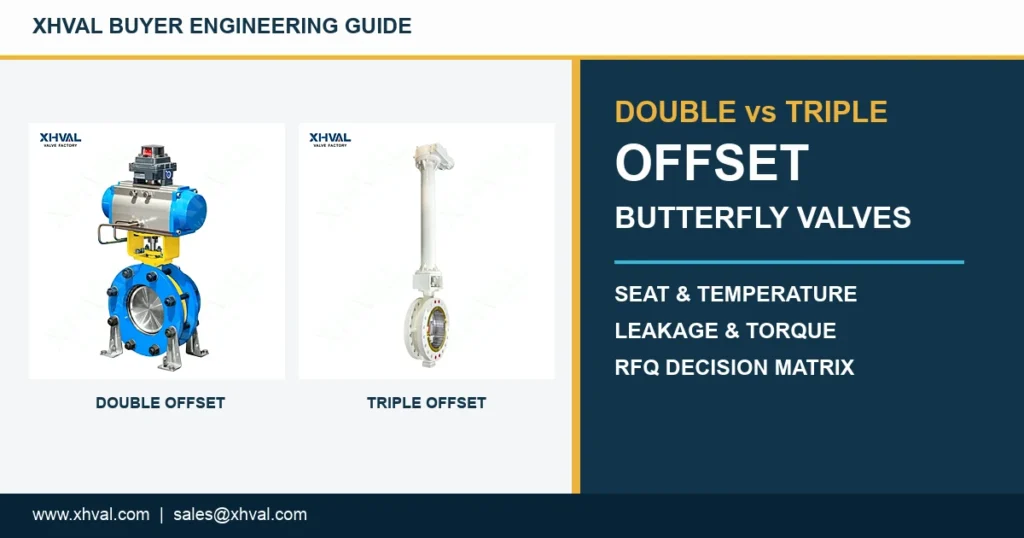
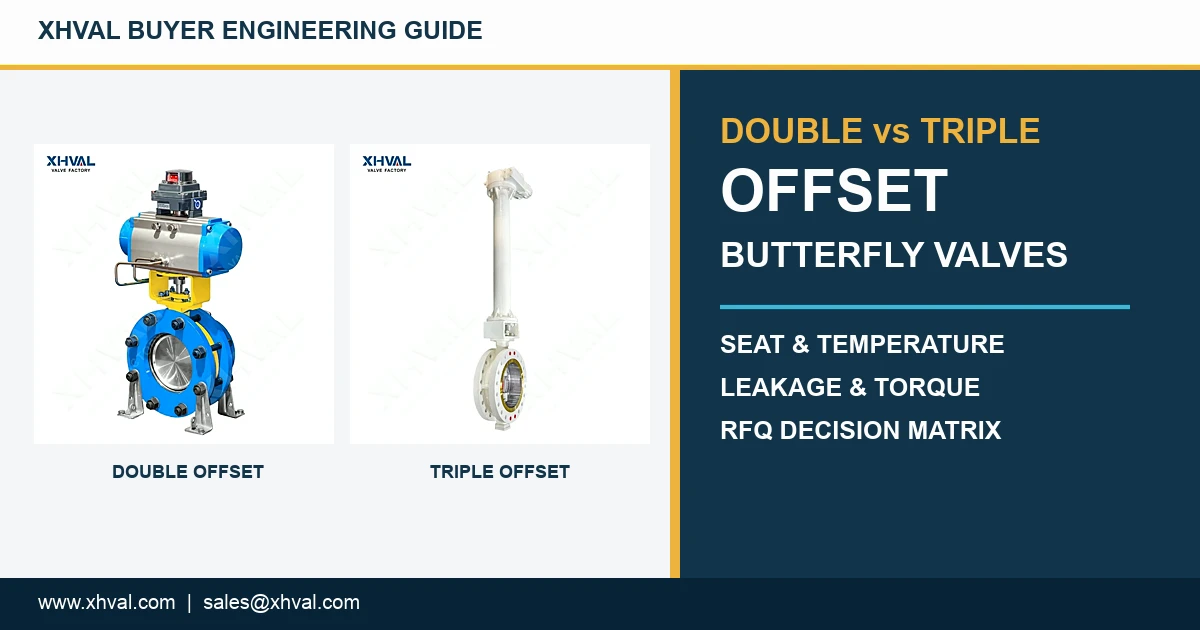
The choice between a double-offset and a triple-offset butterfly valve is not a contest over which design is universally better. It is a service decision. Pressure, temperature, shutoff expectation, operating frequency, media, installation space, maintenance strategy and lifecycle cost should determine the construction.
For buyers, the practical problem is that quotation language often collapses these factors into labels such as “high-performance” or “zero leakage.” A defensible RFQ should describe the duty first, then require each bidder to show how the offered seat and disc geometry meet it.
Quick buyer verdict
Use a double-offset valve when the service suits a resilient or polymer-based seat and compact, efficient quarter-turn isolation is the priority. Consider a triple-offset valve when the duty calls for a metal-seated sealing system, elevated temperature, demanding cycling or a fire-safe design basis. Do not select either design from offset count alone.
| Decision field | Double-offset starting point | Triple-offset starting point | RFQ evidence to request |
|---|---|---|---|
| Seat system | Resilient or polymer seat is common | Laminated or solid metal seat is common | Section drawing, seat material and sealing principle |
| Temperature | Limited by the selected soft-seat compound | Often selected for higher-temperature duty | Published rating for the exact seat/seal stack |
| Disc-seat contact | Offset geometry reduces rubbing | Conical geometry is intended to minimise sliding contact | Opening/closing sequence and torque curve |
| Shutoff | Define direction and leakage acceptance | Define direction and leakage acceptance | Test standard, test pressure, fluid and acceptance rate |
| Fire-safe need | Requires configuration-specific evidence | Metal seat alone does not prove fire-safe performance | Applicable fire-test report and scope |
| Cost basis | Often lower initial cost | Often higher initial and repair cost | Total installed and lifecycle comparison |
1. Start with service conditions, not the valve label
State the fluid, phase, solids content, corrosiveness, design and operating pressure, minimum and maximum temperature, flow velocity, cycling frequency and required service life. Identify whether the valve is for isolation, control, emergency shutdown or a combination of duties.
A soft seat that performs well in clean, moderate-temperature service may be unsuitable for abrasive solids or thermal extremes. Conversely, specifying a triple-offset metal-seated valve for a mild utility duty can add cost, weight and maintenance complexity without improving the operating outcome.
2. Ask the supplier to draw the sealing mechanism
“Double offset” normally describes displacement of the shaft from the seat plane and pipe centreline. “Triple offset” adds an angular or conical sealing geometry. The RFQ should still require a sectional drawing because suppliers may use different seat locations, sealing rings, retainers and body constructions.
Ask the bidder to identify the primary sealing element, the direction of pressure-assisted sealing, the direction of preferred flow and whether shutoff performance is symmetric. Record which component is replaceable and whether replacement can be completed in line.
3. Define leakage without using vague claims
Terms such as “bubble-tight” and “zero leakage” are incomplete unless they are tied to a test method, medium, differential pressure, duration, flow direction and acceptance criterion. Name the governing published standard and edition in the purchase specification, together with any project additions.
Require production test records for the supplied valve and keep type qualification separate from routine acceptance. If bid documents cite API 609, API 598, ISO 5208 or another standard, confirm the scope and edition rather than blending class labels from different documents.
4. Treat temperature as a complete sealing-system limit
The catalogue temperature of one seat material is not necessarily the rated temperature of the assembled valve. Request the allowable range for the complete seat, seal, packing, bearing and gasket system at the stated pressure.
For high-temperature or thermal-cycling service, ask how expansion affects the sealing ring, retainer, shaft, bearings and body. For low-temperature duty, request material impact requirements, stem-seal details and the required test plan.
5. Check torque and actuator sizing at the real duty point
Offset geometry is intended to reduce contact during travel, but actuator sizing must still include seat torque, bearing friction, packing friction, hydrodynamic torque, differential pressure, operating speed and suitable safety factors. Ask for the calculation at minimum and maximum temperature, not only at ambient conditions.
Confirm fail position, available air or electrical supply, manual override, travel stops, mounting interface and maximum allowable stem torque. A low catalogue torque is not useful if it excludes deposits, ageing, thermal effects or the selected seat material.
6. Separate fire-safe construction from fire-test evidence
A metal seat, graphite packing or triple-offset geometry may support a fire-safe design, but those features alone are not a qualification certificate. If fire testing is required, state the applicable standard and edition and request evidence traceable to the offered valve family, size/class range, seat system and manufacturing scope.
The same discipline applies to fugitive-emission claims. Ask whether the evidence covers the assembled valve, the stem-seal system or production acceptance, and match it to the offered configuration.
7. Compare lifecycle work, not just purchase price
Ask for recommended inspection intervals, seat or sealing-ring replacement steps, special tools, spares, field-adjustment limits and post-maintenance tests. A triple-offset valve may justify a higher purchase price in severe service, but only if its construction and evidence reduce the expected operating risk. A double-offset valve may provide the better lifecycle result when its seat limits comfortably cover the duty.
Include actuator, extension, insulation clearance, mating flanges, commissioning spares and expected repair method in the commercial comparison. This prevents a lower valve price from hiding a higher installed cost.
Copy-ready RFQ clause
Bidder shall identify whether the offered butterfly valve is double-offset or triple-offset and provide a sectional drawing showing shaft offsets, seat location, sealing element, retainer and preferred pressure direction. The technical offer shall state seat/seal materials, pressure-temperature limits, leakage test basis, torque calculation inputs, actuator margin, fire-safe and fugitive-emission evidence where required, and maintenance procedure. Qualification evidence shall be traceable to the offered construction and size/class range. All deviations and substitutions shall be listed before award.
Pre-award checklist
- Service, temperature, pressure, media and cycling are defined.
- The sealing mechanism and pressure direction are shown.
- Seat materials and complete assembly limits are confirmed.
- Leakage language names the test and acceptance basis.
- Torque calculations use the real operating envelope.
- Fire-safe and emissions claims have configuration-specific evidence.
- Maintenance access, spares and post-repair tests are documented.
- Installed and lifecycle costs are compared.
Explore XHVAL’s industrial butterfly valve range and the specialist resources at XHVAL Butterfly. For triple-offset applications, review the triple-eccentric butterfly valve range and send the service data, line list, leakage basis and actuator requirements with the enquiry.