
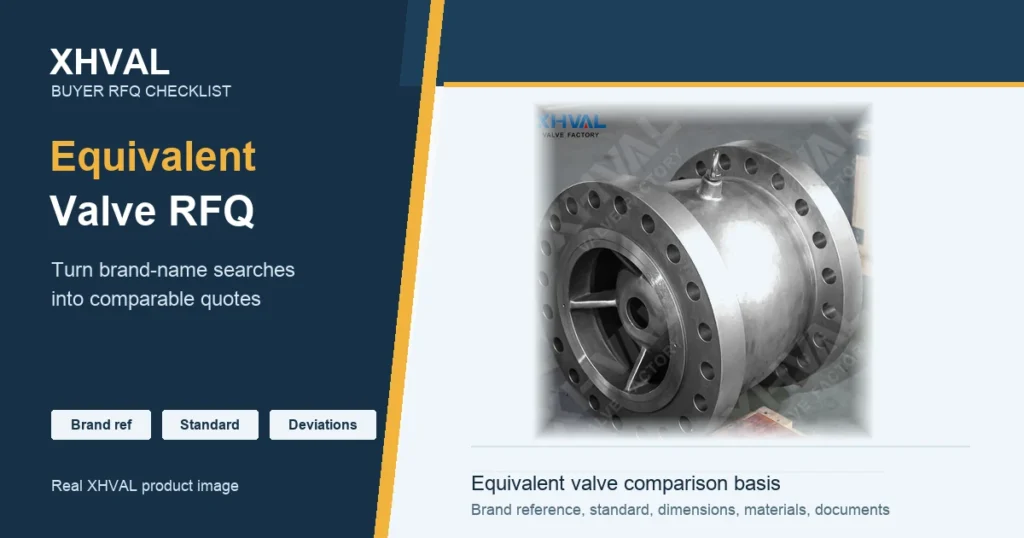
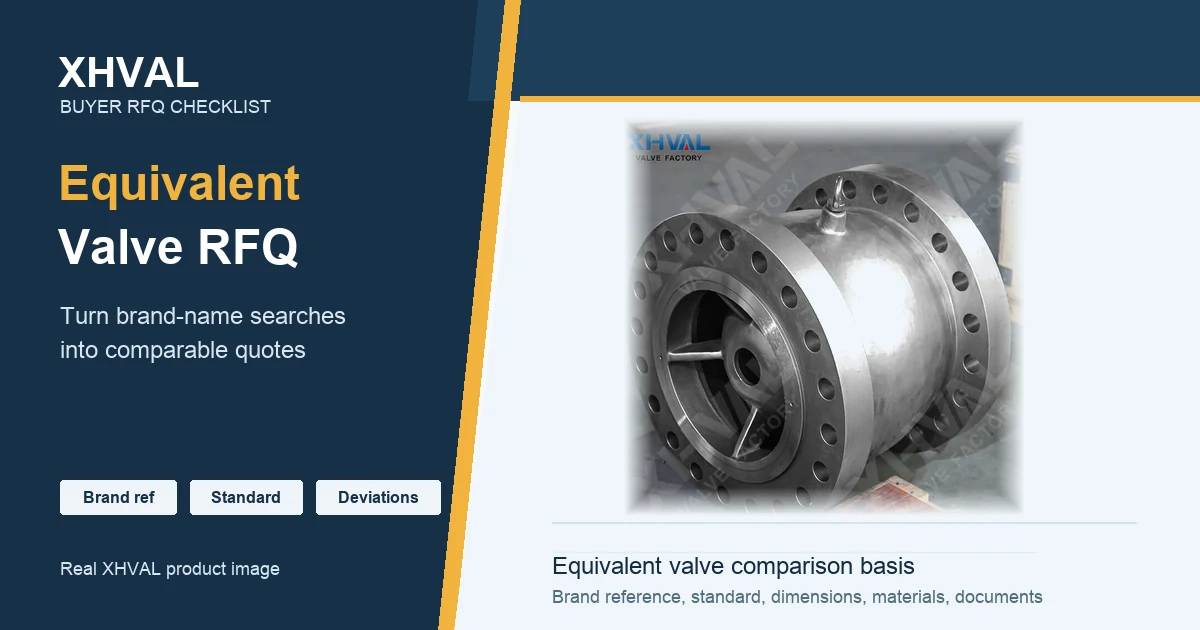
Many industrial valve searches start with a brand name.
A buyer may search for kitz valves, conbraco valves, hydroseal valve company, or another known supplier because they already have a project reference, an old installed valve, a preferred vendor list, or a drawing from a previous purchase.
That search does not automatically mean the buyer only wants the same brand. It often means the buyer needs a comparable valve quotation.
The problem is that many RFQs still say only: Please quote equivalent valve.
That is not enough. An equivalent valve RFQ must define what should be equivalent before price comparison starts.
1. Start With the Existing Reference, But Do Not Stop There
If the buyer has an existing brand, model, tag number, photo, or datasheet, include it in the inquiry.
Then add this sentence:
The reference brand or model is provided for comparison only. Please quote against the technical requirements listed below and declare any deviations.
2. Identify the Valve Type and Design Route
Brand replacement is not a product category. The RFQ should first state the valve type: ball valve, gate valve, check valve, globe valve, plug valve, or butterfly valve.
Then define the design route. For example, a check valve inquiry should say whether the buyer expects swing, dual-plate, piston, tilting-disc, or spring-assisted construction. A butterfly valve inquiry should say whether the requirement is wafer, lug, double-flanged, double offset, or triple offset.
XHVAL keeps product references for check valves, ball valves, gate valves, globe valves, plug valves, and butterfly valves so the valve type can be matched before a quote is compared.
3. State the Standard Basis
API’s public Monogram updates area separates valve standards by product family, including API 594 for check valves, API 600 for steel gate valves, API 608 for metal ball valves, and API 609 for butterfly valves.
That matters because a brand-name search alone does not tell the supplier which standard basis to use.
Please quote the valve against the stated design and test basis. If your offer uses a different standard, edition, test scope, or manufacturer standard, list it as a deviation.
4. Lock the Dimensions That Affect Replacement Fit
For replacement or equivalent supply, the buyer should not assume that every valve with the same nominal size will fit the same piping layout.
- NPS / DN size
- pressure class or PN rating
- end connection
- face-to-face or end-to-end dimension
- flange drilling
- bore or flow path where relevant
- installation orientation
5. Define Materials and Service Conditions
Equivalent pricing is weak if the metallurgy is unclear. Ask suppliers to confirm body, trim, seat, stem, bolting, gasket or seal material, service fluid, temperature, pressure, and corrosion or sour-service requirements where applicable.
6. Ask for Testing and Documentation Scope
A low price may exclude documents that the project expects later. Before comparing quotes, ask whether the offer includes pressure test report, material certificate, dimensional drawing, coating information, inspection and test plan, packing and marking requirements, and actuator documents where applicable.
For check valves, also ask suppliers to clarify flow direction, installation orientation, and any minimum-flow or cracking-pressure assumptions when they affect performance.
7. Require a Deviation List
The deviation list is the control point in an equivalent valve RFQ. Ask every supplier to declare standard differences, material substitutions, dimensional differences, testing exclusions, document exclusions, accessory exclusions, and lead-time assumptions.
If there are no deviations, the quotation should say so clearly. Silence is not the same as equivalence.
Practical RFQ Wording
The listed brand, model, or existing valve reference is provided as a comparison basis. Please quote an equivalent industrial valve package against the stated valve type, standard basis, pressure class, material requirements, dimensions, testing scope, and document scope. Any difference from the reference or RFQ basis must be listed in a separate deviation table.
Buyer Summary
- reference brand, model, tag, photo, or datasheet
- valve type and design route
- standard and edition basis
- size, pressure class, ends, and face-to-face dimensions
- materials and service conditions
- testing and document scope
- deviation list
FAQ Draft
Can a supplier quote an alternative valve against a brand-name reference?
Yes, but the RFQ should say which technical fields must match and which differences must be declared. A brand name alone is not a complete technical specification.
What is the biggest risk in an equivalent valve quote?
The biggest risk is hidden non-equivalence. The price may look attractive because the supplier assumed a different material, dimension, test scope, standard basis, or document package.
Should buyers ask for a deviation list even when the quote looks simple?
Yes. The deviation list is the fastest way to separate true equivalence from hidden assumptions.