
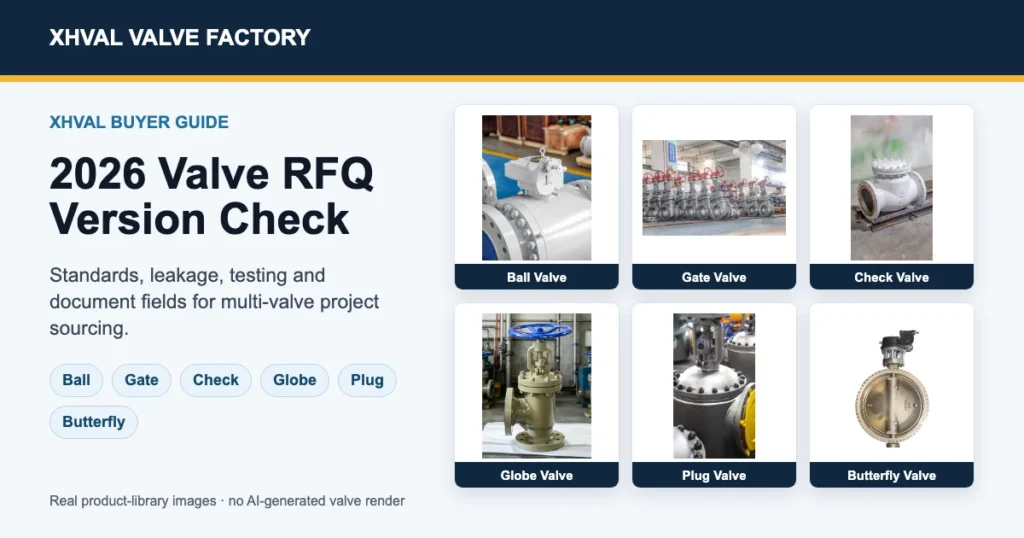
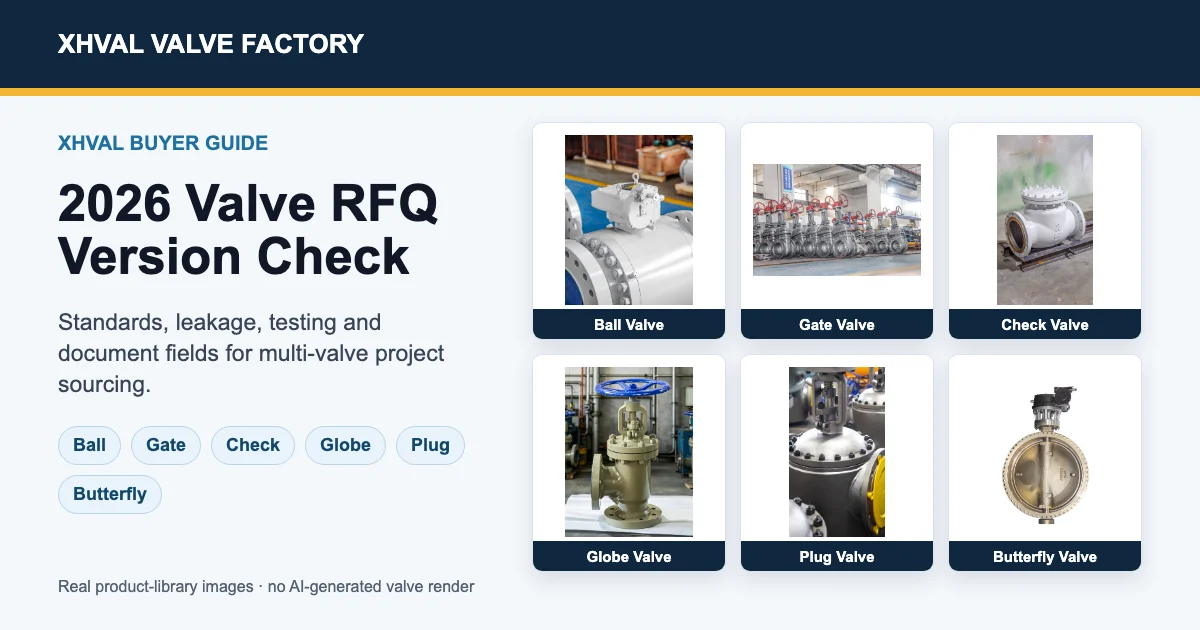
Industrial valve quotations can look comparable on price, size, pressure class, and delivery time. The problem is that a small version gap in the RFQ can change the inspection plan, leakage expectation, certificate package, and even the valve design basis.
For buyers sourcing ball valves, gate valves, check valves, globe valves, plug valves, and butterfly valves in 2026, the safest first step is not to ask for a cheaper unit price. It is to lock the RFQ version fields before the supplier starts quoting.
Before comparing offers, confirm these four items in writing: the exact valve standard and edition required; the test standard and leakage acceptance level; the fugitive-emission or low-emission requirement; and the document package that must be delivered before shipment.
1. Name the Valve Standard and Edition
Many RFQs still list a standard number without an edition. That creates risk when standards are updated, when a project specification references an older edition, or when a bidder assumes a different design basis.
| Valve type | Typical standard field to confirm | RFQ note |
|---|---|---|
| Ball valve | API 6D, API 608, ASME B16.34, fire-safe requirement where applicable | Confirm floating/trunnion design, bore type, end connection, seat material, and anti-static/fire-safe needs. |
| Gate valve | API 600, API 602, ASME B16.34 | Confirm bolted bonnet or pressure seal, trim, wedge type, and rising/non-rising stem. |
| Check valve | API 594, API 6D, MSS SP references where applicable | Confirm swing, dual-plate, piston, tilting-disc, or spring-assisted design. |
| Globe valve | API 623, BS/EN project references, ASME B16.34 | Confirm throttling duty, plug/disc type, flow direction, and packing requirement. |
| Plug valve | API 599 or project-specific plug valve standard | Confirm lubricated/non-lubricated design and cavity/seat sealing requirement. |
| Butterfly valve | API 609, ASME B16.34, project face-to-face and flange standard | Confirm concentric, double-offset, or triple-offset design. For butterfly-valve sourcing, see xhvalbutterfly.com. |
2. Separate Design Standard From Test Standard
A common RFQ weakness is mixing design and testing into one sentence. A valve can be designed to one standard and tested under another. Buyers should separate those fields.
| Field | Example wording |
|---|---|
| Design standard | “Design and manufacture according to API/ASME standard stated in the technical datasheet.” |
| Pressure-temperature rating | “ASME B16.34 pressure-temperature rating, class and material group to be stated by supplier.” |
| Inspection and testing | “Hydrostatic shell test, seat test, and closure test according to the specified test standard.” |
| Leakage class | “State the allowable leakage rate and acceptance basis in the offer.” |
| Witness point | “Buyer or third-party inspection witness required before shipment, if selected in the PO.” |
3. Ask for Leakage and Packing Details Early
Low-emission language is becoming more important in oil, gas, chemical, hydrogen, LNG, and methane-related projects. Do not wait until the inspection stage to ask how the stem packing, body-bonnet gasket, and seat system are handled.
- What packing material and packing structure are included in the base offer?
- Is live-loaded packing available?
- Is fugitive-emission testing required, and to which standard?
- Does the quotation include a low-emission certificate, type test reference, or production test record?
- What seat leakage class is quoted for the service condition?
4. Lock the Document Package Before Price Comparison
Two suppliers may quote the same valve size and class, but not the same document package. That makes price comparison misleading.
| Document | Why it matters |
|---|---|
| General arrangement drawing | Confirms face-to-face, end connection, operator position, and overall dimensions. |
| Material list / BOM | Confirms body, bonnet, disc/ball/wedge, stem, seat, gasket, and packing material. |
| Pressure test report | Shows the actual test basis and result. |
| EN 10204 3.1 material certificate or project-required equivalent | Supports traceability for pressure-retaining parts. |
| Painting and packing standard | Prevents corrosion, transit damage, and site rejection. |
| IOM manual | Helps installation, commissioning, and maintenance teams. |
5. Use Search Terms as a Buyer Intent Signal
Recent search behavior often shows that buyers do not only search for broad product names. They search for standard-led phrases such as “ball valve API 6D”, “API 600 gate valve”, “API 594 check valve”, and “butterfly valve API 609”. Product pages and RFQ forms should show the standard, valve type, pressure class, material, test requirement, and available documents close to the inquiry button.
Practical RFQ Template
Please quote the valve according to the attached datasheet. Confirm valve type, size, class, body/trim/seat material, end connection, operation method, design standard and edition, inspection and test standard, leakage acceptance, packing requirement, painting/packing, delivery time, and included document package. Please list any deviation separately.
Closing Recommendation
For 2026 valve sourcing, the best quotation is not the one with the shortest description. It is the one that makes the standard version, test basis, leakage expectation, and documentation visible before purchase.
XHVAL can support RFQs for industrial ball valves, gate valves, check valves, globe valves, plug valves, and butterfly valves with project-specific standard, material, testing, and document requirements.