
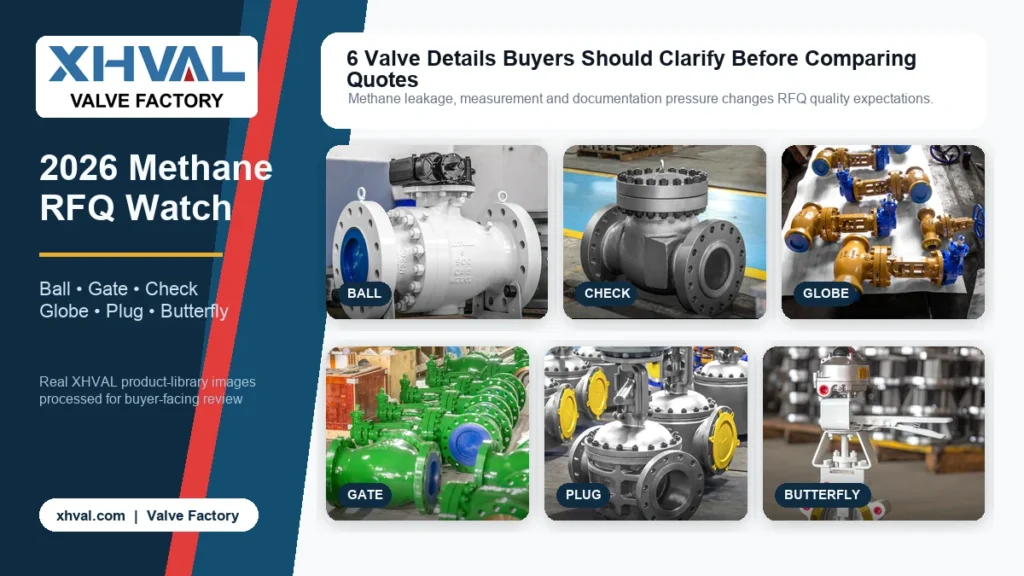
Valve buyers rarely lose time because suppliers do not understand the words ball valve, gate valve, or butterfly valve.
They lose time because the RFQ arrives before the real service basis is visible.
That problem matters more in 2026 because methane performance, measurement, and documentation remain commercially visible. The IEA’s Global Methane Tracker 2026 says methane reductions are still a policy priority, notes that the energy sector accounts for around 40% of methane emissions from human activity, and says the latest edition draws on recent satellite and measurement-campaign data. It also highlights work on marketplaces for fuels with near-zero methane intensity and provides a framework for responding to satellite-detected large-emissions events.
None of that means every industrial valve RFQ must read like a policy paper.
It does mean buyers should reduce avoidable ambiguity before they compare quotations.
Why Methane Pressure Changes RFQ Quality Expectations
In many oil and gas, LNG, refinery, chemical, and energy projects, the buyer already knows more than the first RFQ reveals.
The team often already knows:
- the media and pressure range
- whether shutoff is routine or more sensitive
- whether leakage language may become a review issue later
- whether automation, cycling, or documentation depth will matter
But many RFQs still reduce the request to valve type, size, class, and quantity.
That forces suppliers to price different hidden assumptions. One supplier quotes a lighter commercial basis. Another quotes a stricter interpretation. The buyer then spends another round clarifying what should have been visible at the start.
1. State the service basis, not only the valve family
The RFQ should say more than the valve name.
Useful early fields include:
- media
- operating temperature range
- pressure range
- corrosion or solids concerns if relevant
- isolation duty, throttling duty, or mixed duty
This matters across all product families. A ball valve inquiry for dry gas shutoff does not invite the same quotation logic as a globe valve inquiry for control-oriented duty.
2. Separate shutoff expectation from fugitive-emissions expectation
Buyers often mention tight shutoff and assume every supplier will interpret leakage scope the same way.
That is risky. Seat leakage, external leakage, and fugitive-emissions concerns are related, but they are not the same commercial question.
If leakage performance is likely to affect supplier comparison, the RFQ should say so early. When applicable, buyers may also identify the test or reference basis they expect suppliers to address, such as API 598, ISO 15848, or API 622.
3. Clarify whether testing and acceptance need a named basis
A buyer does not need to list every inspection detail on page one.
But if test scope will change supplier pricing or lead time, the RFQ should say whether the quote is expected to cover:
- shell and seat testing
- additional leakage references
- witness requirements
- MTC or traceability documents
- deviation statements
That matters for a gate valve package just as much as it does for a plug valve package.
4. Show the operating arrangement before suppliers price around assumptions
Valve type alone does not define how the package will be used.
The RFQ should clarify whether the buyer already expects manual gear operation, pneumatic actuation, electric actuation, frequent cycling, or space limits around the actuator or stem arrangement.
This is especially important when a check valve inquiry has flow-behavior sensitivity, or when a ball valve package has automation and cycling expectations that go beyond simple isolation.
5. Split hardware scope from document scope
One of the fastest ways to receive unlike-for-like quotations is to let the hardware scope stay visible while the document scope stays vague.
Before comparing quotes, buyers should decide whether they expect only the valve hardware price or a broader package that also includes data sheets, GA drawings, material lists, inspection plans, packing or sealing references, and lead time by valve and actuator scope.
6. For butterfly valves, say which design route the project already expects
The word butterfly valve is often too broad once the project already knows the service lane.
If the inquiry is still general, buyers can start from our butterfly valve overview or the broader butterfly valve product range on XHVALBUTTERFLY.
If the duty is moving toward higher temperature, metal seating, or more demanding shutoff conditions, buyers should say whether the quote should be framed around a more specific route such as triple eccentric butterfly valves.
Where API 609 or similar butterfly-specific references are already relevant, it is better to show that in the RFQ than wait for the technical clarification round.
How This Looks Across the Main Valve Families
For ball valves, buyers should clarify whether the package is routine isolation, frequent cycling, or gas-service leakage-sensitive work.
For gate valves, buyers should say whether the quotation is purely commodity-oriented or whether document and testing depth will influence award decisions.
For check valves, buyers should identify any sensitivity around reverse-flow behavior, service cleanliness, or installation context.
For globe valves, the RFQ should say whether throttling behavior matters or whether the package is mainly isolation and shutoff focused.
For plug valves, the RFQ should make the media, shutoff expectation, and operating assumptions visible earlier.
For butterfly valves, the biggest avoidable mistake is staying too general after the project already knows whether it needs a standard soft-seated path, a double-eccentric route, or a triple-eccentric route.
Final Takeaway
The current methane signal does not mean every valve buyer needs a long compliance memo.
It does mean 2026 buyers should stop hiding the parts of the RFQ that change supplier interpretation.
If the inquiry makes the service basis, leakage expectation, test scope, operating arrangement, document package, and butterfly-valve route clearer up front, suppliers can quote faster and buyers can compare quotations on a more consistent basis.
FAQ Draft
Do I need to cite methane policy documents in every RFQ?
No. The practical point is not to cite more policy documents. The practical point is to clarify the engineering and commercial fields that methane-sensitive projects are more likely to inspect later.
Should every valve RFQ list API 598, ISO 15848, or API 609?
Not automatically. Those references are useful only when they match the real project basis. The RFQ should state them when they matter, rather than using them as generic filler.