
Many gate valve quotation problems begin before pricing starts.
They begin when the buyer asks for an API 600 gate valve but does not state which edition, which project deviations, or which acceptance basis the supplier should quote against.
That is why a search like api 600 latest edition pdf is useful for research but still too vague for procurement.
API’s public product page lists API Standard 600, 14th Edition, May 2021. API’s public addenda and errata page lists API Std 600, 14th Ed. Errata 1 dated April 25, 2024. ASME’s public page lists B16.34-2020 for valves with flanged, threaded, and welding ends.
Those public references do not write the RFQ for the buyer.
They do show why the RFQ should stop at latest edition language and move to a clear quote basis.
Why “Latest Edition PDF” Is Not a Usable RFQ Field
Suppliers do not compare quotations against a search phrase.
They compare them against a stated technical basis.
If one supplier assumes API 600 14th Edition only, another assumes the 2024 errata is already included, and a third adds purchaser deviations from the end user specification, the first round of quotations is no longer directly comparable.
The document reference should therefore be explicit before the inquiry leaves the buyer team.
For a live gate valve package, that single clarification can save multiple rounds of avoidable revision.
1. State the Governing Standard Package, Not Just the Product Name
The RFQ should say whether the quotation basis is:
API Standard 600, 14th Edition, May 2021API Std 600, 14th Ed. Errata 1, April 25, 2024ASME B16.34-2020for pressure-temperature and end-connection expectations where relevant- purchaser specification and project addenda
- any client or EPC deviation sheet that must override the supplier’s default interpretation
If the buyer wants the supplier to quote to a specific document package, that package should be named directly.
Do not leave the supplier to guess what latest means.
2. Define the Valve Construction Route Early
Gate valve is still a wide commercial label.
Before quote comparison, buyers should write down:
- bolted bonnet, pressure seal bonnet, or another required route
- rising stem or other operating expectation if it matters to the package
- outside screw and yoke or project-specific operating arrangement where required
- manual, gearbox, or actuator expectation
- shutoff duty versus frequent operation expectations
3. Lock Pressure Class, End Connection, and Size Range in the First Round
Buyers should state:
- pressure class
- nominal size range
- flanged, butt weld, socket weld, or threaded end connection
- facing or end-preparation expectations
- any project preference on dimensional or piping interface control
If this scope stays loose, the supplier is forced to build quote assumptions that may not match the project line list.
4. Make Materials and Trim Basis Visible
Material ambiguity is one of the fastest ways to slow gate valve procurement.
The RFQ should show:
- body and bonnet material expectation
- wedge, stem, and seat-ring basis
- trim route if the project uses trim mapping
- corrosion, sour service, temperature, or contamination concerns
- any required coating or preservation notes for storage and shipment
This matters even more when buyers are comparing gate valve packages with nearby globe valve or check valve packages and want one review standard across multiple valve families.
5. Write the Test and Inspection Scope Before Suppliers Price It Differently
Before sending the inquiry, state whether the quotation must include:
- shell and seat test basis
- inspection witness points if any
- hydrostatic, seat, or other project-required test expectations
- inspection and test plan requirements
- third-party inspection assumptions
- marking, tagging, and traceability rules
If the testing package is not visible in round one, buyers often end up comparing different scopes as if they were the same product.
6. Ask for the Documentation Package in the Quotation, Not After Award
For better quote comparison, ask suppliers to confirm whether they are including:
- material test certificates
- general arrangement or outline drawing
- data sheet confirmation
- compliance or deviation list
- pressure test reports
- packing list, nameplate details, and shipment records where required
The buyer does need the supplier to declare what is and is not included.
7. Require a One-Line Quote-Basis Confirmation
Ask the supplier to confirm in one line:
Quoted against API Standard 600, 14th Edition (May 2021), including Errata 1 dated April 25, 2024, plus the purchaser deviations listed in this RFQ.
If the supplier cannot confirm the quote basis that clearly, the comparison round is not ready yet.
Practical Buyer Summary
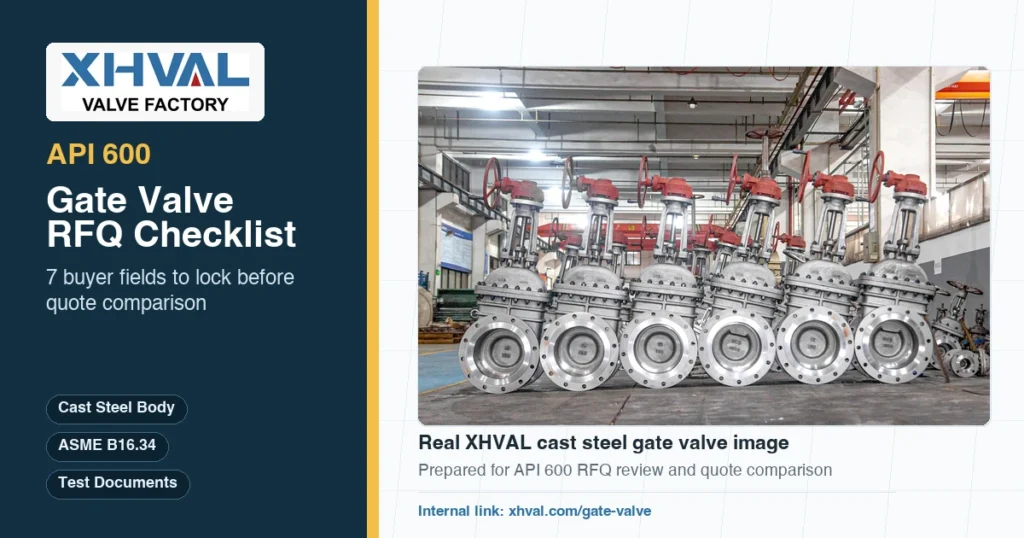
Before comparing API 600 gate valve quotations in 2026, buyers should lock these seven fields:
- governing edition, errata, and purchaser deviations
- valve construction route
- pressure class, size, and end connection
- material and trim basis
- testing and inspection scope
- documentation package
- one-line quote-basis confirmation
That turns latest edition pdf research into a real RFQ.
And that usually produces faster clarification, cleaner comparison, and fewer technical surprises after the first quotation round.