
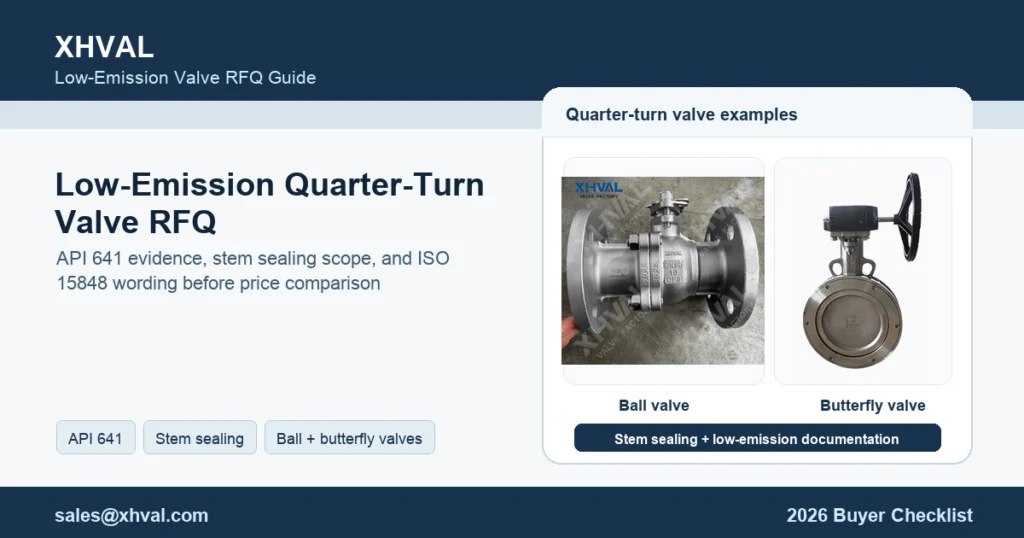
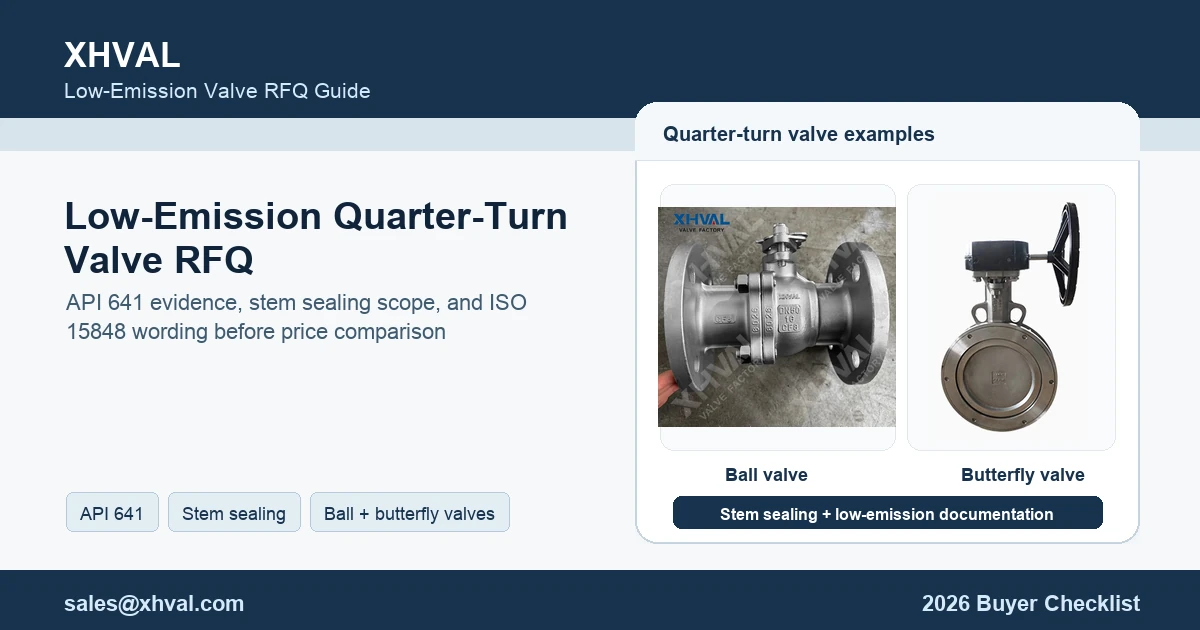
Methane and fugitive-emission discussions are becoming more practical for valve buyers. The question is no longer only whether a valve can shut off flow. Buyers also need to know whether the stem sealing, body joint, testing basis, and document package match the project requirement.
For quarter-turn valves, this usually affects ball valves, butterfly valves, and plug valves. A short inquiry such as “low-emission valve, send price” is not enough for a comparable quotation.
Quick Verdict
If the project mentions fugitive emissions, methane, VOCs, hydrogen blend, refinery service, LNG, chemical service, or export documentation, the RFQ should lock the leakage standard before price comparison.
| RFQ field | What to specify | Why it matters |
|---|---|---|
| Valve type | Ball valve, butterfly valve, or plug valve | API 641 is normally discussed for quarter-turn valve type testing. |
| Leakage requirement | API 641, ISO 15848-1, ISO 15848-2, or project-specific class | Suppliers may otherwise quote different sealing and test scopes. |
| Service | Methane, natural gas, VOC, hydrogen blend, chemical, steam, or other medium | Service changes seal material, test expectation, and documents. |
| Certificate scope | Type test certificate, production acceptance test, or project inspection | A type test and a production acceptance test are not the same thing. |
Why This Matters in 2026
The International Energy Agency’s Global Methane Tracker 2026 keeps methane reduction in focus, especially for oil and gas operations. The IEA highlights leak detection and repair, equipment replacement, and better measurement as practical methane abatement paths.
The U.S. EPA also describes equipment leaks as unintended emissions from components such as connectors, valves, open-ended lines, pressure relief valves, and related equipment. In other words, valves are part of the buyer’s leak-control conversation, not a side detail.
API 641 vs ISO 15848
API 641 is commonly referenced for type testing of quarter-turn valves for fugitive emissions. It is relevant when a buyer is asking about low-emission ball valves, butterfly valves, and plug valves.
ISO 15848-1 is a classification and qualification framework for type testing of industrial valves for fugitive emissions. ISO 15848-2 covers production acceptance testing when fugitive-emission standards are specified for standard production valves.
For 2026 technical review, ISO 12101:2025 is also worth watching. It covers type testing of valve stem seals and applies to stem seals for multi-turn, linear, and quarter-turn valves. It does not replace complete valve assembly testing to ISO 15848-1.
Low-Emission Ball Valve RFQ
- API 608 or API 6D basis, depending on service.
- Floating or trunnion-mounted design.
- Soft seat, metal seat, or project seat material.
- Fire-safe requirement and certificate basis.
- Fugitive-emission requirement: API 641, ISO 15848, or project class.
For general product reference, buyers can start from XHVAL’s Ball Valve page before narrowing the RFQ.
Low-Emission Butterfly Valve RFQ
- Concentric, double eccentric, or triple eccentric design path.
- API 609 or project butterfly-valve standard basis.
- Soft seat or metal seat.
- Stem sealing design and packing material.
- Gear, actuator, or bare-shaft requirement.
- Fugitive-emission test basis and certificate availability.
For butterfly-valve sourcing, buyers can review the focused XHVALBUTTERFLY product range. If the application involves higher temperature, metal seating, or severe-service isolation, the triple eccentric butterfly valve range is the more relevant reference path.
Sample RFQ Wording
Butterfly valve for natural gas service, API 609 basis, Class 300, metal seated, gear operated. Supplier shall state whether API 641 or ISO 15848 evidence is available for the offered valve design. Quote shall list stem packing material, test/certificate scope, temperature basis, leakage class, operator torque, lead time, and any deviation from the requested emission requirement.
Ball valve for methane service, API 608 basis unless supplier recommends API 6D due to duty. Size 6 inch, Class 300, flanged RF ends, fire-safe required. Supplier shall state fugitive-emission certificate basis, whether API 641 and/or ISO 15848 evidence applies to the offered construction, and whether production acceptance testing is included or optional.
RFQ Decision Matrix
| Buyer situation | Better question | Quote risk if unclear |
|---|---|---|
| Buyer only says “low emission” | Which standard and class? | Supplier may quote a generic packing design. |
| Buyer asks for ISO 15848 | Type test or production acceptance? | Certificate may not match the required evidence. |
| Buyer asks for API 641 | Which quarter-turn valve type and design? | Certificate may not apply to the offered construction. |
| Buyer requires actuator package | Who owns torque and mounting responsibility? | Valve and actuator may be quoted as disconnected items. |
Final Buyer Checklist
- Valve type and standard basis.
- Fugitive-emission standard and acceptance level.
- Whether the certificate is for type testing, production testing, or project inspection.
- Service medium, pressure, temperature, and cycling condition.
- Stem sealing material and body joint sealing assumptions.
- Operator or actuator scope.
- Required documents: certificate, drawing, MTC, test report, IOM, and deviation list.
Low-emission valve sourcing should not become a guessing game. A clear RFQ helps the supplier quote the correct sealing design, prevents false low pricing, and gives the buyer a better document trail for project approval.