
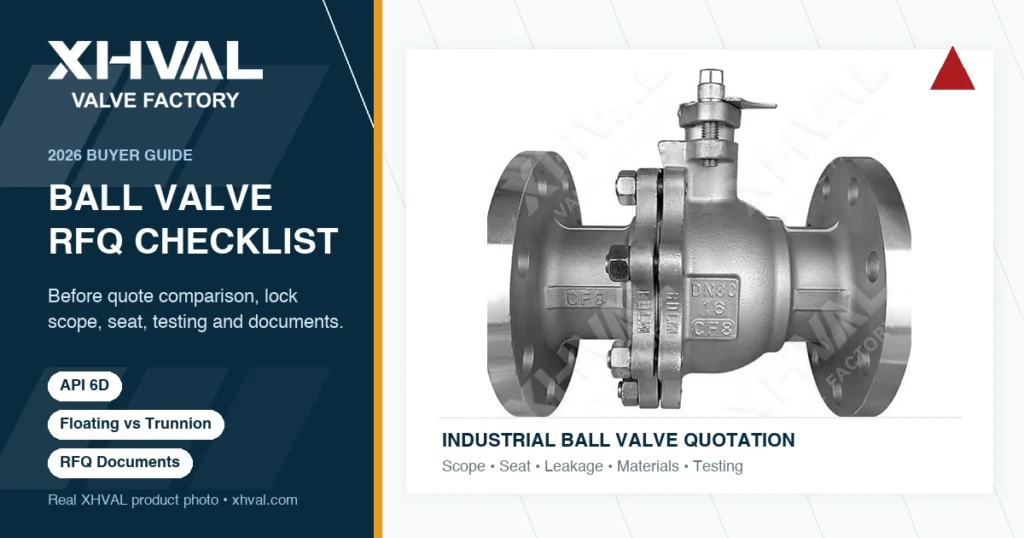
Many ball valve quotation problems do not start with price.
They start with an RFQ that says ball valve but leaves the actual duty, scope, and acceptance basis open to interpretation.
That gap is still expensive in 2026. API’s public Monogram Latest Updates page currently lists Spec 6D, 25th ed., Addendum 3 and its update in March 2025. ISO still lists ISO 15848-1:2015 as current and also lists ISO 15848-1:2015/AWI Amd 2 under development. The IEA’s Global Methane Tracker 2026 says there is no sign that global energy-related methane emissions fell in 2025.
That does not mean every buyer needs to turn a ball valve RFQ into a standards memo.
It does mean buyers should stop asking suppliers to guess what kind of ball valve package is really being priced.
Why Ball Valve RFQs Still Break Down
The label ball valve covers very different commercial problems.
One RFQ means a general process isolation valve. Another means a pipeline valve under API 6D expectations. Another means a leakage-sensitive package where seat performance, emission expectations, and certification depth directly affect supplier selection.
If those assumptions stay hidden, the first quote round is not truly comparable.
It is only a set of different interpretations of the same product name.
1. Is this an API 6D scope, a plant isolation valve, or a mixed package?
Not every industrial ball valve must be quoted as an API 6D product. But if the service, client specification, or project discipline points in that direction, the RFQ should say so early.
Before issuing the request, buyers should make visible:
- whether
API 6Dscope applies or not - whether the valve sits in pipeline service, process service, or a package mix
- whether the valve is mainly on/off isolation or also cycle-heavy
- whether the end user specification overrides the supplier’s standard build
- whether deviations must be declared in the first quote
For a ball valve package, this is usually the first field that changes technical and commercial comparability.
2. Should the supplier assume floating or trunnion, full port or reduced port?
Buyers often know the product family but still leave the mechanical route too open.
Before quote comparison, the RFQ should clarify:
- floating or trunnion design intent
- full port or reduced port expectation
- manual, gear, pneumatic, or electric actuation expectations
- operating torque limits if relevant
- shutoff frequency and cycle expectations
3. What seat, leakage, and low-emission assumptions matter in this service?
The public ISO 15848 pages and the IEA methane signals do not mean every ball valve quote must carry the same leakage narrative.
They do mean buyers should stop leaving seat and leakage assumptions as hidden follow-up questions.
If the service is gas, volatile hydrocarbons, hydrogen-adjacent media, or any review-sensitive fluid, the RFQ should state whether the quote must address:
- soft seat or metal seat expectations
- bidirectional shutoff assumptions
- low-emission or fugitive-emission relevance
- packing sensitivity and stem-seal expectations
- any required declarations on leakage or service limitations
4. Which materials and service conditions are already fixed?
Many RFQs still ask for a ball valve before they state the media, temperature window, or corrosion logic clearly enough.
Before quote comparison, buyers should show:
- process media
- design temperature range
- pressure class
- corrosion or contamination concerns
- fire-safe or special service expectations where relevant
This is especially important when the buyer is comparing ball valves alongside gate valve or check valve packages and wants a consistent technical review standard across product families.
5. What test and document scope belongs in round one?
If the commercial comparison is meant to be serious, the RFQ should state whether the quote must include:
- shell and seat testing basis
- material certificates
- inspection and test plan expectations
- traceability depth
- drawing and datasheet deliverables
- deviation list requirements
The earlier this scope is visible, the less likely the buyer is to compare incomplete packages as if they were equal.
6. Is the RFQ asking for only the valve, or for a usable project package?
Some suppliers quote only the hardware. Others quote hardware plus drawings, test records, coatings, packing notes, and commercial clarifications.
Before the RFQ leaves the buyer team, decide whether the request expects:
- valve only
- valve plus actuation package
- valve plus documentation package
- valve plus inspection support
- valve plus shipment and lead-time breakdown
Practical Buyer Summary
- Have we stated whether this is
API 6Dscope, general process isolation, or a mixed package? - Have we fixed floating versus trunnion and full port versus reduced port assumptions?
- Have we made leakage, seat, and low-emission expectations explicit?
- Have we shown the material and service conditions that affect the technical basis?
- Have we priced the real test and documentation scope into round one?
- Have we separated valve-only pricing from the full commercial package?
FAQ Draft
Does every industrial ball valve RFQ need to cite API 6D?
No. The useful practice is not adding standards titles for decoration. The useful practice is making the intended technical scope explicit so the supplier does not guess wrong.
When should leakage or low-emission expectations appear in a ball valve inquiry?
As early as possible when the service is gas, hydrocarbon, volatile, or otherwise review-sensitive. If leakage expectations appear only after the first quote round, price comparability usually gets weaker.