
When buyers choose an air actuated ball valve, valve size gives only the starting point. First, define the job the valve must do. Then confirm the media, pressure, temperature, body material, seal material, connection type, actuator action, and control accessories.
For buyers and engineers, the main risk is a valve setup that looks correct on paper but does not match the real working conditions. Therefore, use a clear selection process before you request a quote. As a result, the supplier gets better details and can discuss the valve and actuator setup with fewer gaps.
What Is an Air Actuated Ball Valve?
An air actuated ball valve uses compressed air to move a pneumatic actuator, which turns a quarter-turn ball valve open or closed. To choose one, start with the media and operating conditions. Then confirm valve size, connection type, body and seal material, actuator action, control accessories, and fail position before you request a quote.
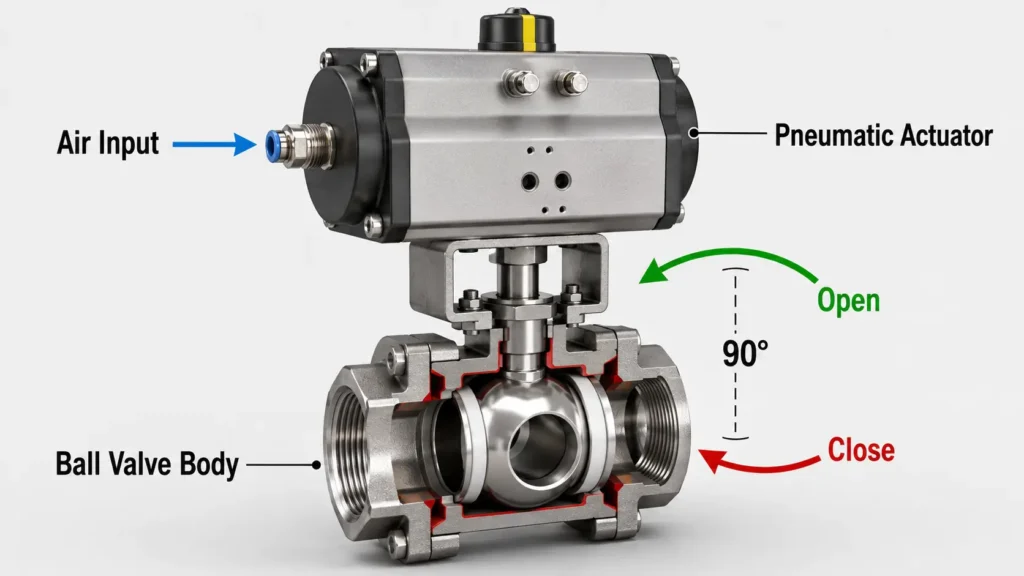
An air actuated ball valve combines two main parts: a ball valve body and a pneumatic actuator.
| Part | What It Does | What to Check |
|---|---|---|
| Ball valve body | Rotates a ball inside the valve to open or close the flow path | Size, pressure class, body material, seal material, connection type, and media fit |
| Pneumatic actuator | Uses compressed air to rotate the valve stem | Actuator type, torque, air supply, fail position, cycle needs, and control accessories |
In a simple open/close application, the actuator rotates the valve between fully open and fully closed positions. This setup helps when an operator cannot reach the valve easily, when a control panel needs remote operation, or when the system needs repeated automatic cycling.
However, choose the valve body and actuator together. For example, the valve body must match the media, but the actuator also needs enough torque and the right control setup. Likewise, the actuator may move correctly, but the valve body and seals still need to match pressure, temperature, and media conditions.
When Should You Choose an Air Actuated Ball Valve?
Choose an air actuated ball valve when the site already uses compressed air or when the valve needs automatic open/close operation. In addition, this option can fit systems that need remote actuation, repeated cycling, or control-panel integration.
However, do not choose air actuation just because it sounds more advanced. Compare manual, air, and electric actuation against the site conditions. For a broader actuator comparison, see XHVAL’s related guide on pneumatically actuated ball valves vs electrically actuated ball valves.
| Choice | When It May Fit | What to Confirm |
|---|---|---|
| Manual ball valve | Simple systems with occasional operation and easy access | Operator access, safety procedure, and operation frequency |
| Air actuated ball valve | Automated open/close service where compressed air already exists | Air supply, actuator type, valve torque, fail position, and controls |
| Electric actuated ball valve | Sites without compressed air or projects that prefer electric control | Power supply, duty cycle, environment, speed, and control needs |
In short, start with the application. Ask what the valve must do, what media it handles, and what should happen if air or signal stops.
How to Choose an Air Actuated Ball Valve
A practical selection process starts with valve function. Next, check the application conditions. Finally, match the actuator and control options to the job.
Selection Criteria Table
| Item to Confirm | Why It Matters | What to Ask the Supplier |
|---|---|---|
| Valve function | Different tasks may need on/off isolation, switching, diverting, or another control method | Does the system need simple open/close service, 2-way shutoff, or 3-way flow routing? |
| Media | Media affects body material, seal material, and material-fit review | What fluid or gas will pass through the valve? Is it corrosive, clean, viscous, abrasive, or regulated? |
| Pressure and temperature | These conditions affect the valve body, seals, and actuator sizing | What normal and maximum pressure and temperature ranges should the valve handle? |
| Valve size | Size affects flow capacity, connection, and actuator torque | What pipe size or flow requirement should the valve match? |
| Body material | Material choice affects corrosion resistance, cost, and application fit | Does the project prefer stainless steel, carbon steel, brass, PVC, or another material? |
| Seal material | Seats and seals affect media fit and temperature limits | Which seal material do you prefer, or should the supplier review it based on the media? |
| Connection type | Connection affects installation and replacement | Does the system use threaded, flanged, welded, sanitary, or another connection? |
| Actuator action | Actuator action determines how the valve opens and closes | Does the project need a double-acting or spring-return actuator? |
| Fail position | Fail position matters when air or control signal stops | Should the valve fail closed, fail open, or stay in its last position? Ask the project engineer to review this point. |
| Control accessories | Accessories affect automation and feedback | Does the system need a solenoid valve, limit switch, positioner, air filter/regulator, or manual override? |
| Documentation | Some projects need drawings, material records, or other documents | What documents does the project require for approval or buying? |
Use this table as a selection guide, not as a substitute for engineering review. For example, chemical, high-temperature, high-pressure, sanitary, hazardous, or regulated applications need closer review of material fit and documents before purchase.

Double-Acting vs Spring-Return Air Actuators
Actuator action plays a major role in an air actuated ball valve assembly. Therefore, confirm this choice early in the buying process.
| Actuator Type | How It Works | Common Consideration | What to Confirm |
|---|---|---|---|
| Double-acting actuator | Compressed air moves the actuator in both opening and closing directions | Teams often consider it when they can supply air for both directions | Air supply, control valve setup, torque need, and desired response |
| Spring-return actuator | Compressed air moves the actuator in one direction, and spring force moves it back | Teams often consider it when the valve needs a defined return position after air loss | Required fail position, spring torque, process risk, and working conditions |
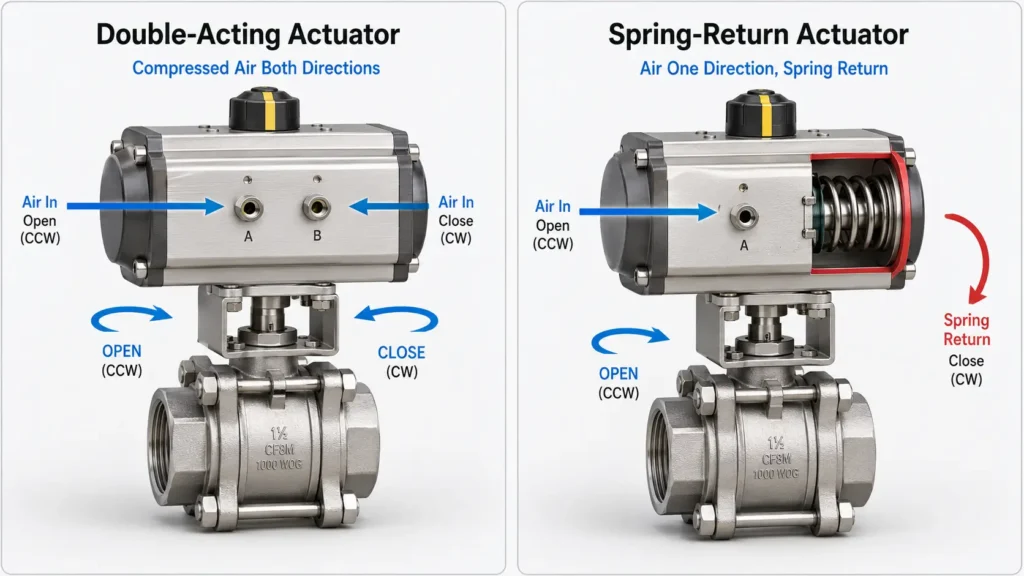
Do not treat one actuator type as always better. Instead, compare the process, control design, air supply, torque need, and required valve response when air or signal stops.
ATO vs ATC and Fail Position
ATO and ATC often appear in actuator and control-valve discussions.
| Term | General Meaning | Typical Fail-Position Logic | Selection Note |
|---|---|---|---|
| ATO | Air to open | Many setups link it with fail closed when air stops | Confirm the actuator design and process requirements |
| ATC | Air to close | Many setups link it with fail open when air stops | Confirm the actuator design and process requirements |
Do not select fail position casually. For example, one system may need fail closed to stop flow. Another system may need fail open to maintain or relieve flow. Because the risk differs by process, ask the project engineer or process safety team to confirm the choice.
Application Conditions That Affect Valve Selection
Select an air actuated ball valve around real working conditions. A product name alone does not prove that a valve assembly fits the application.
| Application Condition | Why It Affects Selection | Safe Selection Approach |
|---|---|---|
| Media type | Corrosive, viscous, abrasive, clean, or regulated media can require different body and seal materials | Provide the exact media name and concentration when relevant |
| Pressure range | Pressure affects valve body rating, sealing, and actuator torque | Share normal and maximum pressure values |
| Temperature range | Temperature affects body material, seat material, seals, and actuator environment | Share normal, maximum, and cleaning or steam conditions if they apply |
| Cycle frequency | Frequent cycling may affect actuator sizing and component choice | Estimate how often the valve opens and closes |
| Installation environment | Outdoor, wet, dusty, corrosive, or hazardous environments may need different protection | Describe the installation area and exposure |
| Control requirement | Basic on/off control differs from position feedback or modulating control | Confirm whether the valve only opens and closes or needs feedback or signal control |
| Documentation need | Some projects need drawings, inspection documents, or material records | List required documents before quotation |
Also, do not assume that a valve that fits one water, chemical, or process line will fit another. Media concentration, temperature, pressure, cleaning method, and cycle frequency can all change the final choice.
Accessories and Control Options to Confirm
An air actuated ball valve assembly may need more than a valve body and actuator. The right accessories depend on the control system and working environment. For broader automation context, see XHVAL’s related guide on ball valve automation considerations.
| Accessory / Option | Function | When to Consider It | Confirmation Needed |
|---|---|---|---|
| Solenoid valve | Controls air flow to the pneumatic actuator | Use it when a panel, PLC, or switch needs electrical control of the actuator | Voltage, port size, enclosure needs, and control logic |
| Limit switch box | Provides open/closed position feedback | Use it when the control system needs valve-position feedback | Signal type, enclosure, indicator type, and wiring needs |
| Positioner | Helps control valve position instead of simple open/close movement | Consider it when the system needs modulating or partial-position control | Confirm whether the valve design fits the control task |
| Air filter/regulator | Helps condition and regulate compressed air | Use it when air supply quality or pressure needs control | Air pressure range and site air quality |
| Manual override | Allows manual operation under certain conditions | Consider it for maintenance or emergency operation plans | Access method and safety procedure |
| Mounting bracket/coupling | Connects the actuator and valve stem | Use it when matching the actuator to the valve | Mounting standard, stem size, torque, and alignment |
Before you quote, confirm accessory needs with the supplier. In addition, do not assume every accessory fits every valve size, material, or actuator type.
Common Selection Mistakes to Avoid
Choosing by Pipe Size Only
Pipe size matters, but it does not tell the whole story. The same nominal valve size can require different materials, seals, pressure ratings, actuator torque, and connection types.
Ignoring Media and Temperature
Media and temperature can affect both the valve and the seals. Therefore, give full application details when the media is corrosive, abrasive, viscous, high-temperature, or part of a regulated process.
Treating “Air Actuated” as a Complete Specification
“Air actuated” only describes the actuation method. It does not define the valve material, pressure rating, seal material, actuator action, fail position, or control accessories.
Using a Standard Ball Valve for Continuous Throttling Without Review
Teams often use standard ball valves for fully open or fully closed service. However, if the application needs continuous throttling or precise flow regulation, confirm whether the valve design and actuator/control package fit that duty.
Forgetting the Fail Position
If compressed air or control signal stops, the valve response can matter. Therefore, confirm whether the valve should fail closed, fail open, or remain in its last position, and ask the project engineer to review that choice.
Leaving Accessories Until the End
Solenoid valves, limit switches, positioners, air regulators, and manual overrides can affect the final setup. So, clarify these needs before quotation to reduce redesign or requoting.
RFQ Checklist for Air Actuated Ball Valves
Before you request a quote, prepare as much application detail as possible. A clear RFQ helps the supplier discuss the valve and actuator setup more accurately. You can also review XHVAL’s general ball valve information before you prepare your inquiry.
Basic Valve Information
- Valve size or pipe size
- 2-way or 3-way valve requirement
- Full port or reduced port preference, if known
- Connection type: threaded, flanged, welded, sanitary, or other
- Preferred body material, if known
- Preferred seat or seal material, if known
Operating Conditions
- Media name and concentration, if relevant
- Normal and maximum pressure
- Normal and maximum temperature
- Flow direction or flow path requirement
- Cycle frequency
- Indoor or outdoor installation
- Any corrosive, wet, dusty, or special environment
Actuator and Control Requirements
- Double-acting or spring-return actuator
- Required fail position: fail closed, fail open, or other
- Available air supply pressure
- Solenoid valve requirement
- Limit switch or position feedback requirement
- Positioner or modulating control requirement
- Manual override requirement
- Control voltage or signal, if known
Buying and Documentation
- Quantity
- Drawing or datasheet requirement
- Material document requirement
- Inspection or testing document needs
- Packaging or marking needs
- Destination country or project location, if relevant
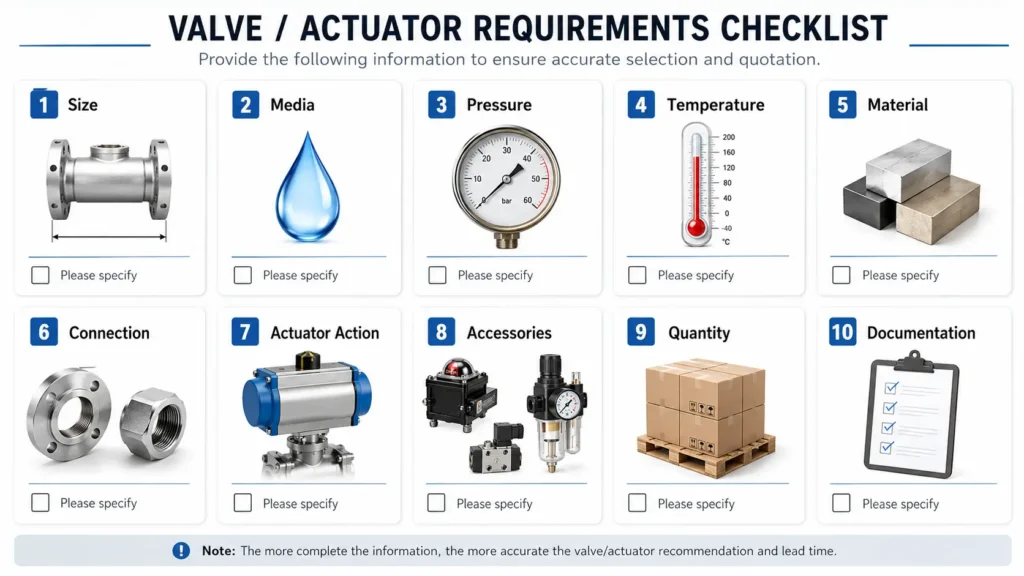
If you do not know some details, say so in the inquiry. Then the supplier can identify which points need technical review before quotation.
FAQ
What is an air actuated valve?
An air actuated valve uses compressed air through a pneumatic actuator. The actuator turns air pressure into movement that opens, closes, or positions the valve, depending on the valve and actuator design.
What is an air actuated ball valve used for?
Teams often consider an air actuated ball valve for automated open/close service when a quarter-turn ball valve needs remote operation or control-system integration. However, application fit depends on media, pressure, temperature, material, seal, connection, actuator, and control needs.
What is the difference between double-acting and spring-return actuators?
A double-acting actuator uses compressed air to move the actuator in both directions. A spring-return actuator uses compressed air in one direction and spring force for the return movement. Therefore, choose based on air supply, control design, torque need, and desired fail position.
What is the difference between ATO and ATC valves?
ATO usually means air to open, while ATC usually means air to close. In many setups, air-to-open links to fail-closed behavior, and air-to-close links to fail-open behavior. However, confirm the final fail position through engineering review because process risk changes by system.
How do I choose an air actuated ball valve?
First, define the valve function and application conditions. Then confirm media, pressure, temperature, valve size, connection type, body material, seal material, actuator action, air supply, fail position, and control accessories. For demanding applications, ask the supplier or project engineer to review material fit and actuator sizing.
What information should I prepare for an RFQ?
Prepare valve size, media, pressure and temperature range, connection type, preferred body and seal material, actuator action, fail position, air supply, accessories, quantity, and required documents. As a result, the supplier can discuss the valve and actuator setup with fewer missing details.
Can an air actuated ball valve control flow rate?
Teams often use a standard ball valve for fully open or fully closed service. However, if the system needs continuous throttling or precise flow control, confirm whether the valve design, actuator, and control accessories fit that task. In some cases, another valve type or a specific control package may fit better.
Need Help Reviewing an Air Actuated Ball Valve Specification?
If you are preparing an RFQ for an air actuated ball valve, share the application details before you choose only by size or actuator type.
Useful details include valve size, media, pressure and temperature range, connection type, preferred body and seal material, actuator action, fail position, air supply, control accessories, quantity, and documentation needs.
Contact XHVAL with your application details so the team can discuss the valve and actuator setup for your project scope. Finally, confirm suitability, documents, lead time, and quotation details based on the specific application and order scope.