
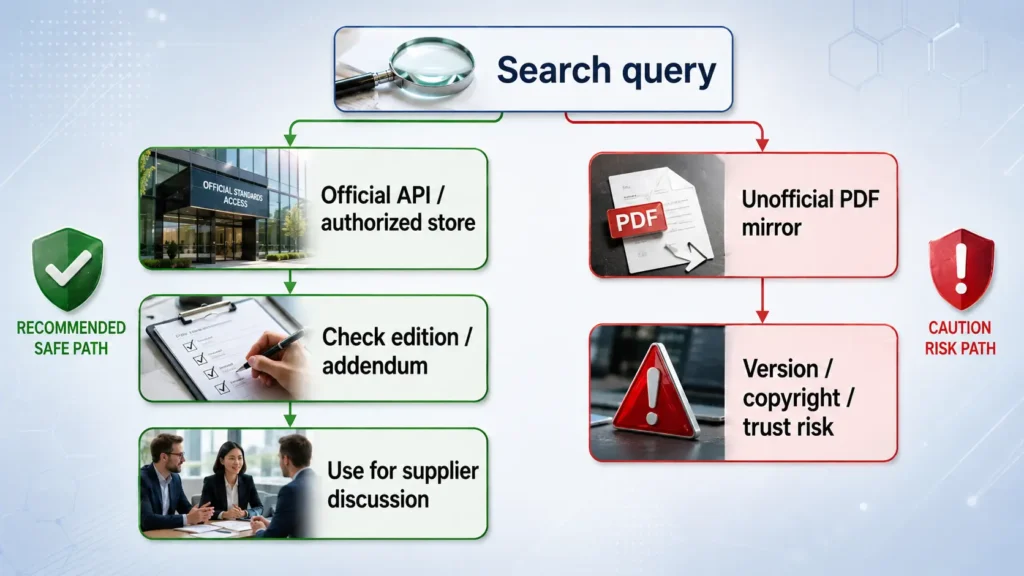
If you searched for “API 622 free download,” you probably need to confirm a valve packing or fugitive-emission requirement before talking to a supplier. Buyers, engineers, and procurement teams often start with that search because a project specification mentions API 622 but does not explain how to use it.
However, API 622 is not just a document title to download. It belongs to a wider fugitive-emission discussion. Therefore, you need to confirm the document source, the standard scope, and the supplier evidence before you use the term in an RFQ, datasheet review, or technical submittal.
Can You Download API 622 for Free?
Access API 622 through official API standards channels or authorized standards-store channels when you need a current document for purchasing, engineering review, or project documentation. Also, avoid unofficial PDF mirrors because they may create version, copyright, or trust problems. Some addenda or errata may appear separately, but that does not mean the full current standard is free. For valve buying, confirm the correct standard, edition, and document scope with your supplier.
What Is API 622?
Engineers and buyers commonly reference API Std 622 in fugitive-emission discussions for industrial valves because it focuses on process valve packing. In buyer-friendly terms, API 622 covers type testing of process valve packing for fugitive-emission considerations.
This distinction matters because packing plays an important role in valve sealing performance. However, a packing-focused standard does not automatically prove that a supplier tested the finished valve as a complete valve assembly.
When a supplier mentions API 622, ask what the statement describes:
- the packing material;
- the packing test evidence;
- the valve type;
- the finished valve test evidence, if your project requires it;
- the standard edition or addendum the supplier references;
- whether the document applies to the selected valve configuration.
As a result, you avoid a common procurement mistake: accepting a vague “API 622” statement before you know whether it applies only to packing or also supports a finished-valve requirement.
API 622 vs API 624 vs API 641
API 622, API 624, and API 641 often appear in the same fugitive-emission discussion. However, each standard points to a different evidence question.
| Standard | What it focuses on | Typical valve relevance | What to ask a supplier |
|---|---|---|---|
| API 622 | Type testing of process valve packing for fugitive-emission considerations | Packing-level evidence | Did the packing pass API 622 testing? Which edition or addendum does the supplier reference? |
| API 624 | Valve-level fugitive-emission type testing for rising and rising-rotating stem valves that use packing previously tested to API 622 | Finished-valve context for certain stem valve types | Does the selected valve have API 624-related evidence, or does the supplier only show packing evidence? |
| API 641 | Valve-level fugitive-emission type testing for quarter-turn valves | Finished-valve context for quarter-turn valves | Does the selected quarter-turn valve have API 641-related evidence? |
| Project specification | The buyer’s or project owner’s actual requirement | Determines what evidence the buyer needs | Which exact standard, edition, valve type, and document scope does the project require? |
For broader background on valve fugitive-emission testing, read XHVAL’s related guide: Fugitive Emissions and API Testing for Valves.

API 622 helps buyers discuss packing evidence. However, buyers should not treat it as the complete answer for every valve requirement.
A packing test helps evaluate packing performance. By contrast, a finished-valve requirement may call for valve-level evidence, depending on the valve type, project specification, and required standard. For example, a rising-stem valve discussion may involve API 624, while a quarter-turn valve discussion may involve API 641.
Ask: “Does this evidence apply to the packing only, the finished valve, or both?”
Then compare the answer with your project requirement. This simple step keeps the discussion clear and reduces the risk of accepting a supplier statement that sounds complete but does not match the required document scope.
What to Ask a Supplier When API 622 Is Mentioned
When a supplier mentions API 622, do not stop at the standard name. Instead, ask for the document scope and how the evidence applies to your selected valve.
Use this checklist before RFQ or technical review:
- Which standard does the supplier reference: API 622, API 624, API 641, or another project requirement?
- Which edition, addendum, or document version does the quotation use?
- Does the evidence apply to packing, the finished valve, or both?
- What valve type will the supplier provide?
- What packing material or packing system does the supplier reference?
- Can the supplier share a test report, certificate, declaration, or datasheet for review?
- Does the document match the quoted valve size, pressure class, material, and configuration?
- What service media, temperature, and pressure conditions should the team consider?
- Does the end user, EPC, or owner require project-specific documentation?
- Should you request valve-level evidence such as API 624 or API 641 because of the valve type?

Supplier Claim Wording to Question
Some supplier statements sound useful at first. However, buyers often need one more question to confirm the claim scope. Use the table below to clarify the statement without turning the conversation into a dispute.
| Supplier says | Why it may be unclear | Safer follow-up question |
|---|---|---|
| “API 622 packing” | The statement may refer only to packing-level evidence. | Does the evidence apply only to the packing, or also to the finished valve? |
| “Low-emission valve” | The supplier does not name the standard, test method, or document scope. | Which standard and test report support this statement? |
| “API compliant” | The supplier does not identify the exact API standard. | Do you mean API 622, API 624, API 641, or another API requirement? |
| “Report available” | The report may not match the selected valve configuration. | Does the report match the quoted valve type, size, class, material, and packing? |
| “Suitable for fugitive-emission service” | Suitability depends on project conditions and required evidence. | What service conditions and documents should our team review before approval? |
Therefore, procurement teams should avoid asking only for a generic “API 622 certificate.” Instead, they should ask about document scope, valve type, and the exact project requirement.
FAQ
Can I download API 622 for free?
For engineering or procurement use, use official API or authorized standards-store channels for the current document. Also, avoid unofficial PDF mirrors because they may create version, copyright, or trust problems. Some addenda or errata may appear separately, but that does not make the full current standard a free document.
What is API 622?
API 622 relates to type testing of process valve packing for fugitive-emission considerations. In practice, buyers should treat API 622 as packing-focused evidence. Therefore, they should ask whether the supplier also has finished-valve evidence when the project requires it.
What is the difference between API 622 and API 624?
API 622 focuses on valve packing. By contrast, API 624 covers a valve-level fugitive-emission testing context for rising and rising-rotating stem valves equipped with packing previously tested to API 622. Therefore, if your project requires finished-valve evidence, ask whether API 624 applies to the selected valve.
What is API 641?
API 641 covers the related valve-level fugitive-emission testing context for quarter-turn valves. If the selected valve uses a quarter-turn design, ask whether the project requires API 641 evidence for that configuration.
Does API 622 prove the finished valve meets fugitive-emission requirements?
Not by itself. API 622 supports packing evaluation. However, a project may require valve-level documentation such as API 624 or API 641, depending on the valve type and project specification.
What documents should I ask a valve supplier for?
Ask which standard the supplier references, which edition or addendum applies, what report or document the supplier can share, and whether the evidence applies to packing, the finished valve, or both. Also, check whether the evidence matches the selected valve configuration and service conditions.
Need Help Reviewing Valve Documents or Standards Requirements?
If your project mentions API 622, API 624, API 641, or another fugitive-emission requirement, first prepare the valve type, size, pressure class, material, service conditions, and required document scope.
Then contact XHVAL with those details and ask what standard-related information may be available for the selected valve and project requirement.
For a clearer request, avoid asking only, “Do you have API 622?” Instead, ask: “Here is our valve type and project requirement. Please confirm what standard-related documents may be available for this selected valve and whether the evidence applies to packing, the finished valve, or both.”