
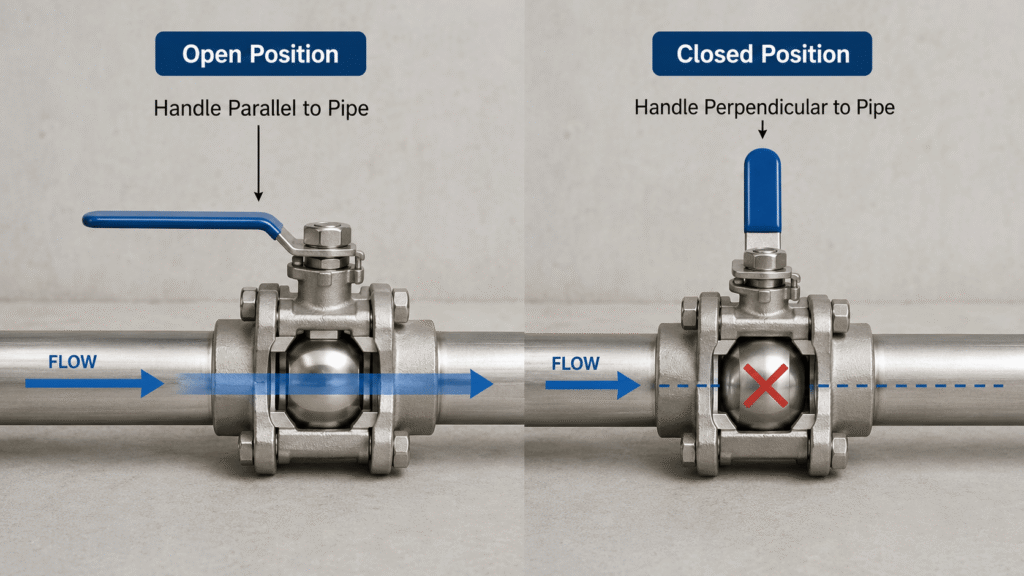
Does a Ball Valve Have a Flow Direction?
Many standard two-way ball valves can work with flow from either direction, but not every ball valve should be treated that way. Some designs, port patterns, vented structures, or special-service valves may have a required flow direction. Before installation or ordering, check the valve body arrow, nameplate, datasheet, port layout, and manufacturer or supplier instructions.
For buyers and engineers, the safest rule is simple: do not assume flow direction from the handle alone. Confirm it from the valve design and documentation.
Flow Direction Is Not the Same as Handle Direction
A common mistake is to treat the ball valve handle as proof of the required flow direction. The handle is useful, but it normally tells you whether the valve is open or closed. It does not always tell you whether the valve must be installed in a specific flow direction.
| Item | What it tells you | What it does not always tell you |
|---|---|---|
| Handle parallel to pipe | The valve is often in the open position on many manual ball valves | Whether the valve is bidirectional or directional |
| Handle perpendicular to pipe | The valve is often in the closed position on many manual ball valves | Whether one side must face upstream |
| Arrow on valve body | The intended or required flow direction when provided | Whether all similar-looking valves follow the same rule |
| Port pattern | Which ports connect inside the valve | Full application suitability without checking the datasheet |
| Datasheet or IOM document | Product-specific installation and operating guidance | Anything outside the documented conditions |
For a simple manual two-way ball valve, the handle can help an installer identify whether the valve is open or closed. For directional valves, three-way valves, vented valves, V-port valves, or special-service designs, the handle should not replace the valve markings or technical documentation.
When Does Ball Valve Flow Direction Matter?
Ball valve flow direction matters when the valve design, internal structure, or system function depends on flow entering from a certain side or routing through a certain port.
In a basic shutoff application, a standard two-way ball valve is often selected because it can provide straightforward open/close control. But in a real project, the valve may not be a plain shutoff valve. It may include a vent hole, a special seat arrangement, a V-port control element, or a three-way port pattern. Those details change what the buyer or installer should check.
Flow direction is more likely to need closer review when:
- the valve body has a flow arrow;
- the nameplate or datasheet states an installation direction;
- the valve is vented or designed for cavity relief;
- the valve is a three-way L-port or T-port design;
- the valve is a V-port or control-style ball valve;
- the valve is used in a sensitive process condition;
- the application has specific media, pressure, temperature, or operating requirements;
- the buyer needs drawings, IOM documents, or project documentation before purchase.
The important point is not that every directional mistake produces the same result. The important point is that the risk depends on valve design and application conditions. If direction is unclear, confirm it before installation.
Which Ball Valve Types Need Direction Checks?
Use the table below as a practical starting point. It is not a replacement for the manufacturer’s datasheet or installation manual.
| Ball valve type | Is flow direction usually fixed? | What to check | Buyer / engineer note |
|---|---|---|---|
| Standard two-way manual ball valve | Often not fixed, depending on design | Body marking, datasheet, handle position for open/closed status | Good for basic shutoff questions, but still confirm markings before installation |
| Two-piece ball valve | Often bidirectional, but design still matters | Flow arrow, seat arrangement, datasheet | Do not assume every two-piece valve follows the same rule |
| Vented ball valve | May have a specified direction | Vent hole, body arrow, nameplate, datasheet | Direction can matter because the venting function depends on design |
| Three-way ball valve | Direction depends on port pattern and routing | L-port or T-port layout, handle position, port labels | Confirm which ports connect in each handle position |
| V-port ball valve | Direction should be checked with manufacturer documentation | V-port orientation, seat side, control direction, datasheet | Do not rely on generic two-way valve rules |
| Special-service or automated ball valve | Direction depends on design and application | Valve documentation, actuator setup, system requirements | Confirm with supplier or manufacturer before ordering or installation |
This table is useful for screening, but it should not be treated as a universal rule. If the valve has a marking or document that specifies direction, follow that instruction.
How to Check Ball Valve Flow Direction Before Installation
Before installing a ball valve, use a step-by-step check instead of relying on memory or appearance.
Pre-installation direction checklist
- Check the valve body. Look for a cast, stamped, engraved, or printed flow arrow.
- Check the nameplate or tag. Some valves include direction or service notes on the plate.
- Check the datasheet. Look for installation direction, port diagram, venting notes, or seat orientation.
- Check the IOM document. Installation, operation, and maintenance instructions are more reliable than visual assumptions.
- Check the port layout. This is especially important for three-way valves.
- Check whether the valve is vented. If a vent hole is present, direction may be specified.
- Check whether the valve is V-port or control-style. These designs may require a preferred flow direction.
- Check the system drawing. Confirm which side is upstream and downstream in the actual piping layout.
- Ask the supplier or manufacturer when unclear. Provide the valve type, size, material, media, pressure, temperature, and operating condition.
A buyer preparing an RFQ should not simply ask, “Is this valve directional?” A better question is: “For this valve model and application condition, is there a required installation direction, and can you provide the marking, drawing, or datasheet that confirms it?”
Special Case: 3-Way Ball Valve Flow Paths
Three-way ball valves are different from simple two-way shutoff valves because the ball has a port pattern that connects different flow paths. The most common discussion is around L-port and T-port designs.
| 3-way ball valve type | General routing idea | What the buyer must confirm |
|---|---|---|
| L-port | Often used to switch flow between two paths | Which two ports connect in each handle position |
| T-port | Often used for diverting, mixing, or allowing multiple flow combinations | Whether the required port combinations match the process |
| Multi-position 3-way valve | Flow path changes as the handle or actuator position changes | Port labels, handle stops, actuator position, and system drawing |
Before ordering or installing a three-way valve, confirm:
- port labels;
- L-port or T-port design;
- handle or actuator positions;
- required flow path in each operating mode;
- whether the valve is used for diverting, mixing, or switching;
- whether a drawing or port diagram is available.
This helps prevent a common selection problem: choosing a valve that looks correct from the outside but does not route flow the way the system requires. For product navigation, you can review XHVAL’s 3-way ball valve page, then confirm project-specific details before quoting.
Buyer / Procurement Checklist Before Ordering
If flow direction may matter, procurement should collect more than size and connection type. A clearer RFQ reduces back-and-forth and helps the supplier confirm what documentation is needed.
RFQ information to prepare
- Valve type: two-way, three-way, V-port, vented, automated, or special-service.
- Valve size and connection type.
- Body and seat material requirements, if already specified.
- Media or fluid type.
- Pressure and temperature range.
- Flow direction requirement, if known.
- Whether a body arrow or nameplate direction marking is required.
- Whether a port diagram is needed.
- Whether an installation manual or datasheet is required before purchase.
- Upstream/downstream arrangement in the system drawing.
- Manual handle, gear operator, pneumatic actuator, or electric actuator requirement.
- Quantity and project timeline, if available.
- Any documentation expectations for the project.
Questions to ask the supplier
- Is this valve design bidirectional, or does it have a required flow direction?
- Does the valve body have a flow arrow?
- Is there a vent hole, seat orientation, or port pattern that affects installation direction?
- Can you provide a datasheet, drawing, or IOM document?
- For three-way valves, which ports connect in each handle or actuator position?
- For V-port or special-service valves, is there a preferred flow direction?
- What information do you need from our side to confirm the correct valve configuration?
These questions do not replace engineering review, but they help buyers avoid vague RFQs and make supplier communication more useful. You can also use the ball valve category page as a product-navigation starting point before sending application details.
Common Mistakes to Avoid
Mistake 1: Assuming every ball valve is bidirectional
Many standard ball valves may allow flow from either direction, but not all ball valves should be installed by assumption. If the valve has a marking, datasheet instruction, or special internal design, follow the documented direction.
Mistake 2: Using the handle as the only guide
The handle often shows open or closed status. It should not be the only basis for deciding flow direction on a directional valve.
Mistake 3: Ignoring arrows or nameplates
If the valve body shows a flow arrow, treat that arrow as important. Do not install against a directional marking unless the manufacturer’s documentation confirms that it is acceptable.
Mistake 4: Treating three-way valves like two-way valves
Three-way valves require port-pattern checks. The key issue is not only “which way does flow enter?” but “which ports connect in each position?”
Mistake 5: Asking a supplier a vague question
“Can I install this either way?” may not give enough context. A better request includes valve type, media, pressure, temperature, connection, port layout, and any drawing or documentation requirements.
Mistake 6: Making safety or performance assumptions without evidence
Incorrect orientation may create application risk depending on the valve design and system conditions. Avoid turning that into a universal claim. Confirm the requirement from the datasheet, installation document, or supplier.
FAQ
Does a ball valve have a flow direction?
Some ball valves have a required flow direction, while many standard two-way ball valves may allow flow from either direction. The answer depends on the valve design. Always check the body arrow, nameplate, datasheet, or manufacturer instruction before installation.
Are ball valves unidirectional or bidirectional?
Ball valves can be either bidirectional or directional depending on design. A standard two-way shutoff valve is often bidirectional, but vented valves, V-port valves, three-way valves, and special-service designs may require closer direction checks.
How do I know which way to install a ball valve?
Start with the valve body. Look for a flow arrow or marking. Then check the nameplate, datasheet, installation manual, and port layout. If the valve is three-way, vented, V-port, automated, or special-service, confirm direction with the supplier or manufacturer.
Is handle direction the same as flow direction?
No. On many manual ball valves, the handle position helps show whether the valve is open or closed. It does not always confirm whether the valve itself has a required flow direction. Directional valves should be checked by markings and documentation.
Do 3-way ball valves have a fixed direction?
A three-way ball valve should be checked by port pattern and required routing. L-port and T-port designs connect ports differently. Before installation or ordering, confirm the port diagram, handle position, and intended flow path.
Can wrong flow direction cause leakage or failure?
Do not assume the same result for every valve. Incorrect orientation may create application risk depending on valve design, pressure, media, seat arrangement, venting, or port pattern. The safe approach is to confirm direction before installation.
Confirm the Valve Details Before Quotation
If you are selecting a ball valve for a project, prepare the valve type, media, pressure and temperature range, connection standard, port layout, operating method, and any drawings or datasheets.
For a direction-sensitive application, ask for confirmation of the required flow direction before purchase or installation. Clear application details help the supplier review what information is needed for selection, documentation, and quotation.
Contact XHVAL with your application details when you are ready to request review or quotation support.