
What Is a Ball Valve Actuator?
The basic function
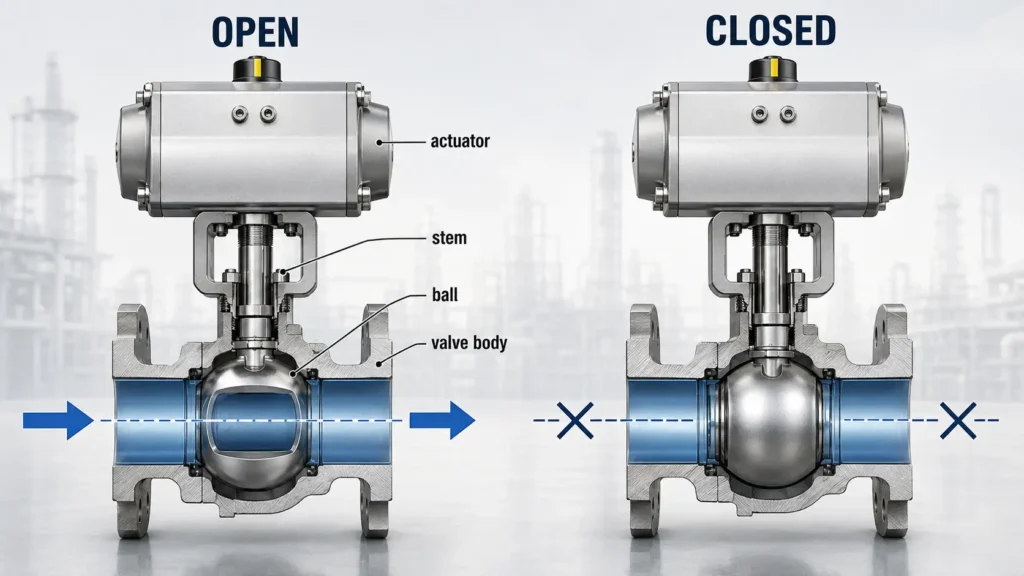
A ball valve actuator opens, closes, or controls a ball valve without relying only on a hand lever. Inside the valve, the stem turns the ball so the flow path opens, closes, or moves to the required control position.
Because ball valves normally use rotary movement, the actuator must turn the stem rather than push it in a straight line. In simple terms, the actuator gives the valve the motion and force it needs to move.
When automation helps
A manual lever may suit a small valve that workers can reach easily. However, an electric or pneumatic actuator may suit a valve that needs remote operation, frequent cycling, control-system connection, or a defined fail position.
Two ways buyers use the term
Buyers often use “ball valve actuator” in two ways. First, some users mean the actuator only. They already have a valve and need an actuator that matches the valve stem, mounting interface, torque requirement, and control method.
Second, other users mean a complete actuated ball valve assembly. This package usually includes the ball valve, actuator, mounting kit, and accessories such as a solenoid valve, limit switch, positioner, or manual override when the project needs them.
How to choose the safer buying path
The safer purchasing path depends on what you already know. If the valve already sits in the line, match the actuator to that valve. If the project is new, a complete actuated assembly can reduce matching risk because the supplier can review the valve, actuator, and mounting parts together.
Before you buy an actuator separately, confirm:
- valve size and type;
- body and seat material;
- stem and mounting interface;
- operating torque requirement;
- media, pressure, and temperature;
- open/close or modulating control need;
- available electricity, air, or hydraulic supply;
- required fail position.
Also, do not select an actuator only because the valve size appears to match. Valve size gives one input, but operating conditions and torque requirement still guide the final choice.
Ball Valve Actuator Types Compared
Compare by power source and control need
Ball valve actuators are usually grouped by how they operate. Common categories include manual, electric, pneumatic, and hydraulic actuators. Instead of looking for one “best” type, compare the options against the site conditions.
| Actuator Type | Power / Operation | Common Fit | Selection Notes | Caution |
|---|---|---|---|---|
| Manual actuator | Hand lever, gear operator, or handwheel | Simple local operation | Works well when the site does not need automation and workers can reach the valve | Does not suit remote or frequent operation well |
| Electric actuator | Electric motor | Remote on/off or control where the site has electrical power | Can support automated control and position feedback when the configuration includes those functions | Check voltage, control signal, duty cycle, enclosure needs, and cycle speed |
| Pneumatic actuator | Compressed air | Industrial automation where the plant has stable air supply | Often supports fast operation and fail-open or fail-close designs when the project uses the right configuration | Requires suitable air supply and control accessories |
| Hydraulic actuator | Hydraulic pressure | High-force or special industrial applications | May fit projects that need hydraulic power and higher force | Adds system complexity and needs engineering review |
In practice, this table helps narrow the options. However, it does not replace engineering review. The final actuator still needs to match the valve and the operating conditions.
Electric vs Pneumatic Ball Valve Actuator
Use the site conditions as the starting point
Electric and pneumatic actuators are common choices for ball valve automation. However, the right choice depends on the site, the control system, and the process risk.
| Selection Question | Electric Actuator May Fit When… | Pneumatic Actuator May Fit When… | Check Before RFQ |
|---|---|---|---|
| What energy source is available? | The site has suitable electrical power | The site has stable compressed air | Voltage, phase, air pressure, and site utilities |
| How will the valve be controlled? | The control system uses electric wiring, signals, or position feedback | The plant already uses pneumatic control systems | On/off vs modulating control, signal type, feedback needs |
| Is fail position required? | The design includes a suitable fail-safe option or backup system | The project needs spring-return fail-open or fail-close behavior | Required fail position and risk review |
| Where will it operate? | The actuator enclosure suits the environment | Air quality and accessories suit the site | Indoor/outdoor, moisture, dust, corrosion, temperature |
| How often will it cycle? | The motor and duty cycle fit the operating pattern | The air supply and actuator size fit the cycle demand | Frequency, speed, duty cycle, maintenance access |
Therefore, avoid a simple “electric is better” or “pneumatic is better” answer. A pneumatic actuator can work well in one plant, while an electric actuator can make more sense in another. In both cases, review power availability, control design, operating environment, valve torque, and fail-position requirements.
Sizing and Matching Factors
Start with torque, not valve size alone
Actuator sizing plays a major role in reliable valve operation. A common mistake is to choose the actuator only by nominal valve size. As a result, the actuator may lack enough torque, move too slowly, become oversized, or fail to match the mounting interface.
Instead, engineers usually start with valve operating torque. Then they review application factors such as pressure, media, temperature, frequency of operation, and design conditions. This article does not provide a sizing calculator because proper sizing needs valve-specific torque data and application details.
Review the full application
| Factor | Why It Matters | What to Confirm |
|---|---|---|
| Valve operating torque | The actuator must provide enough torque to open and close the valve | Start torque, end torque, service factor, supplier torque data |
| Valve size and type | Size affects torque, but it does not determine torque alone | 2-way or 3-way, full port or reduced port, valve series |
| Media | Some fluids or gases affect seat friction, corrosion risk, or material choice | Water, steam, oil, gas, chemical, slurry, or other media |
| Pressure | Pressure can affect operating torque and body or seat selection | Working pressure and pressure variation |
| Temperature | Temperature can affect seals, seats, actuator components, and torque | Minimum and maximum operating temperature |
| Mounting interface | The actuator and valve must connect correctly | Stem size, bracket, coupling, ISO 5211 or other interface |
| Power or air supply | The actuator must match site utilities | Voltage, air pressure, hydraulic supply |
| Control method | Different control goals need different accessories | On/off, modulating, feedback, position indication |
| Fail position | Some processes need the valve to move to a defined position when power or air stops | Fail-open, fail-close, fail-in-place, or no defined fail action |
| Environment | The actuator and accessories must suit the installation area | Indoor/outdoor, dust, moisture, corrosion, washdown, temperature |
When in doubt, send the operating conditions to the supplier or engineering team for review. This step gives them the context they need before they suggest an actuator path.
1. Media and material compatibility
Media affects the valve body, seat, seal, and sometimes the actuator accessories. For example, water, compressed air, oil, gas, steam, and chemicals can call for different materials and sealing choices.
Therefore, do not assume compatibility from a product name alone. Check the actual media, concentration, temperature, pressure, and process needs.
2. Pressure and temperature
Pressure and temperature affect both valve selection and actuator sizing. Higher pressure or difficult service conditions may increase torque demand. Also, temperature can affect seals, seats, lubrication, and accessory performance.
For this reason, include working pressure, maximum pressure, normal operating temperature, and temperature extremes in the RFQ.
3. Control signal and automation goal
Some applications only need open/close operation. Others need position feedback, modulating control, or integration with a PLC or control panel.
Before selecting the actuator, confirm:
- on/off or modulating control;
- required input signal;
- feedback or limit switch needs;
- local manual override requirement;
- open/close speed requirement;
- duty cycle or cycle frequency.
4. Fail position
Fail position can affect process risk, so review it carefully. Some systems need the valve to close when air or power stops. Others need it to open or stay in the last position.
A spring-return pneumatic actuator may support fail-open or fail-close behavior when the project uses the right configuration. However, the team must review the correct fail action for the actual process. Do not treat fail-safe wording as a general safety guarantee.
5. Installation environment
Check electric actuators and accessories against the installation environment. Key conditions include moisture, dust, corrosion, outdoor exposure, and any classified or regulated area requirements.
For hazardous, sanitary, food, pharmaceutical, or regulated applications, do not rely on assumptions. Instead, ask for the exact documents, standards, ratings, and product configuration that apply to the project.
RFQ Checklist for Ball Valve Actuator Selection
Send enough details to reduce guesswork
A good RFQ helps the supplier review the valve and actuator configuration. It also reduces assumptions. Before requesting a quote, prepare as much of the following information as possible.
| RFQ Item | What to Provide | Why It Helps |
|---|---|---|
| Valve size | DN/NPS size or existing valve details | Helps identify valve body and actuator range |
| Valve type | 2-way, 3-way, full port, reduced port, existing model if any | Affects torque and flow path |
| Body material | Stainless steel, carbon steel, brass, PVC, or other material | Helps match media and environment |
| Seat/seal material | PTFE, reinforced PTFE, metal seat, or unknown | Affects torque and compatibility |
| Media | Fluid or gas handled by the valve | Helps review material and sealing requirements |
| Pressure | Normal and maximum working pressure | Affects valve and actuator review |
| Temperature | Normal and maximum/minimum temperature | Affects seals, seats, and actuator accessories |
| Connection type | Threaded, flanged, welded, tri-clamp, or other | Helps match piping system |
| Actuator type preference | Electric, pneumatic, hydraulic, manual, or open to recommendation | Speeds up selection discussion |
| Power or air supply | Voltage, phase, air pressure, hydraulic supply | Helps check site utility fit |
| Control requirement | On/off, modulating, PLC signal, feedback, limit switch | Helps select control accessories |
| Fail position | Fail-open, fail-close, fail-in-place, or not required | Supports process risk review |
| Quantity | Prototype, replacement, project batch, or regular order | Helps prepare the commercial discussion |
| Installation environment | Indoor/outdoor, wet, dusty, corrosive, classified area if relevant | Helps review enclosure and accessory needs |
Mark unknown items clearly
You do not need every detail before the first discussion. However, you should mark unknown items clearly. It is safer to write “unknown” than to guess and receive the wrong actuator recommendation.
FAQ
What is a ball valve actuator?
A ball valve actuator operates a ball valve by turning the valve stem. It may use manual force, electricity, compressed air, or hydraulic power. In automated systems, it helps the valve open, close, or move to a control position without direct hand operation.
What does a ball valve actuator do?
It gives the valve the motion and force it needs to move between positions. For a ball valve, the actuator usually turns the internal ball so the flow path opens or closes.
What are the main types of ball valve actuators?
Common actuator categories include manual, electric, pneumatic, and hydraulic. Manual operation often suits simple local valves. Electric and pneumatic actuators often support automation. Hydraulic actuators may fit special applications that need hydraulic power and higher force.
Should I choose an electric or pneumatic ball valve actuator?
Choose based on site conditions. Electric actuators may fit when the site has suitable electrical power, wiring, and electric control. Pneumatic actuators may fit when the plant already has compressed air and needs fast operation or spring-return fail positioning. In both cases, check valve torque, power or air supply, control needs, environment, and fail-position requirements.
How is a ball valve actuator sized?
Engineers should size a ball valve actuator from valve operating torque and application conditions. Valve size alone is not enough. Pressure, temperature, media, seat material, cycle frequency, mounting interface, and fail-position requirements can all affect selection.
Should I buy an actuator separately or a complete actuated ball valve assembly?
If you already have a valve, first confirm the valve torque, stem, mounting interface, and operating conditions. Then select an actuator that matches those details. For a new project, a complete actuated ball valve assembly can reduce matching risk because the supplier can review the valve, actuator, bracket, and accessories together.
What information should I provide when requesting a quote?
Prepare valve size, valve type, body material, media, pressure, temperature, connection type, actuator preference, available power or air supply, control signal, fail-position requirement, installation environment, and quantity. These details help the supplier review the configuration with fewer assumptions.
Can this article confirm hazardous, sanitary, or regulated application suitability?
No. This article cannot confirm suitability for hazardous, sanitary, food, pharmaceutical, or regulated applications. Those projects need exact product documents, ratings, material information, and engineering review. Do not use a general actuator description as proof of compliance or application suitability.
Need Help Reviewing a Ball Valve Actuator Configuration?
Prepare your valve size, media, pressure, temperature, body material, connection type, available power or air supply, control signal, fail-position requirement, quantity, and installation environment. Then send these details to the supplier’s technical or sales team so they can review the actuator selection path with the right application context.