
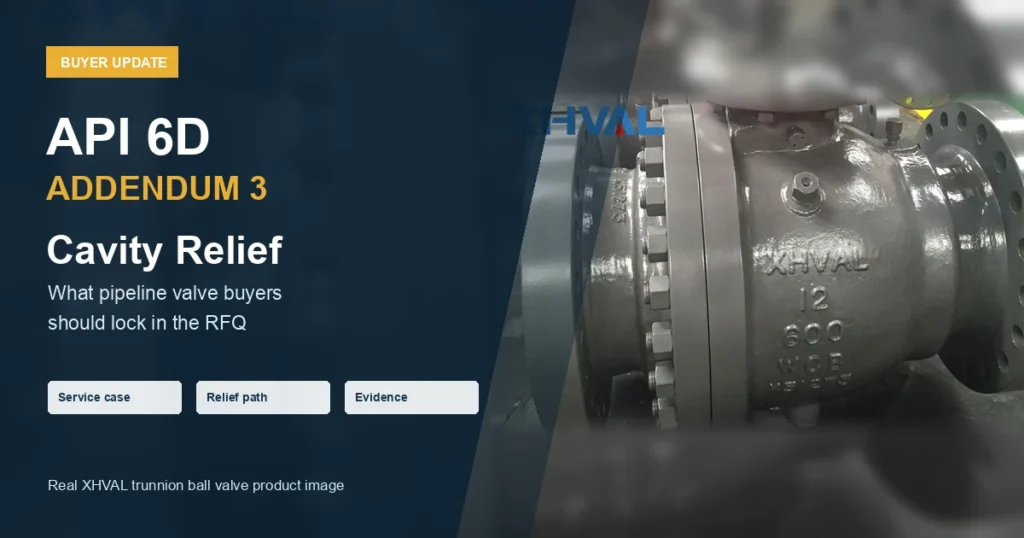
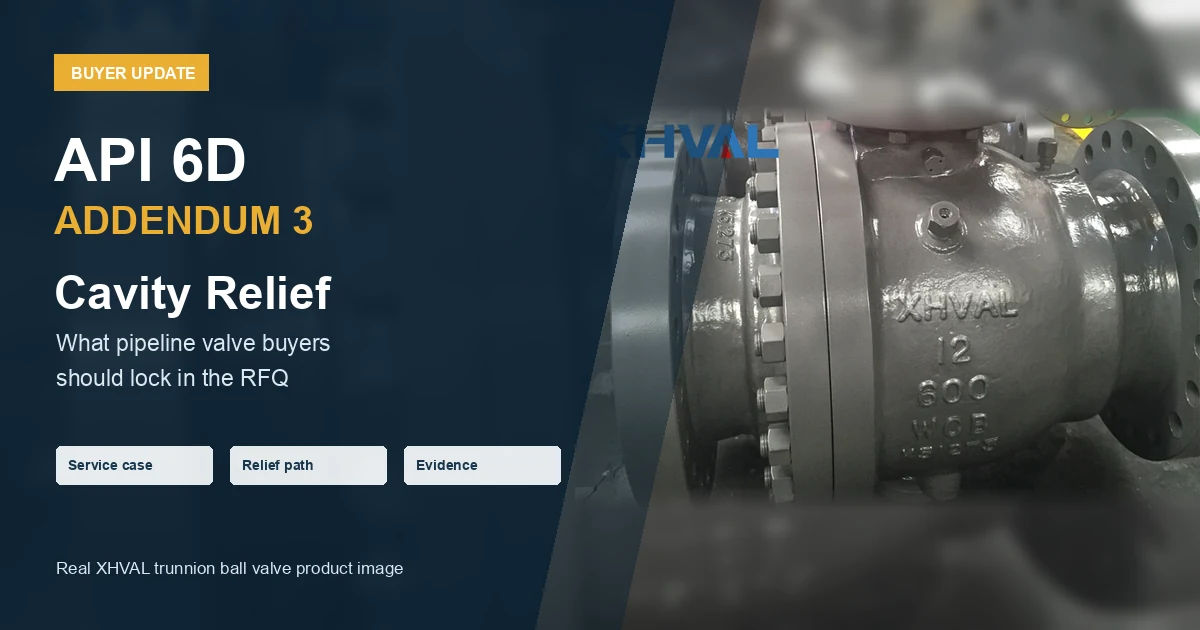
API published Addendum 3 to the 25th edition of API Specification 6D in March 2025. Its API Monogram Program effective date was September 5, 2025. For pipeline ball valves and other valves that can trap liquid in the body cavity, the practical purchasing question is no longer simply “Does the valve comply with API 6D?” The RFQ should identify the governing edition and addendum, the service condition, and the proposed cavity-relief arrangement.
Quick buyer verdict
If liquid can be trapped, ask the supplier to state whether automatic cavity relief is provided, where pressure is relieved, the set or calculated relief basis, and how the design is verified. Do not infer these points from “API 6D” on a quotation.
Why trapped cavity pressure matters
A closed valve can isolate fluid inside its body cavity. If the trapped liquid warms, thermal expansion can raise cavity pressure even when the adjacent pipeline pressure remains stable. The correct response depends on valve design, seat arrangement, flow direction, medium, temperature, and the project’s piping philosophy.
Addendum 3 makes the cavity-relief discussion more explicit. The publicly available API notice states that automatic cavity relief is required where liquid trapping is possible. It also distinguishes service up to 250°F (121°C) from gas or multiphase service above that temperature, where the manufacturer determines the need for cavity relief and specifies the relief pressure and higher shell design pressure.
Seven RFQ fields to lock
| RFQ field | What the buyer should state or request | Why it changes the offer |
|---|---|---|
| Governing document | API 6D, 25th edition, including applicable Addendum 3 | Avoids edition-only declarations that omit later requirements. |
| Fluid phase | Liquid, gas, multiphase, or a credible operating range | Cavity behavior and the required engineering review depend on phase. |
| Design conditions | Normal, maximum and upset pressure/temperature | Thermal expansion and shell design cannot be checked from class alone. |
| Trapping scenario | Seat arrangement, closure condition and whether liquid may be isolated | Establishes whether automatic cavity relief is needed. |
| Relief destination | Upstream, downstream, bidirectional self-relief, or external system | A relief path must be compatible with process safety and flow direction. |
| Verification evidence | Design calculation, drawing, seat schematic and pressure-test procedure | Makes the proposed design reviewable rather than implicit. |
| Deviation list | Every exception, assumption and project interface | Prevents commercial comparison of technically different valves. |
A better RFQ sentence
Trunnion-mounted pipeline ball valve to API 6D, 25th edition, including applicable Addendum 3. Supplier shall review all normal, upset and shutdown cases for trapped-cavity pressure; identify the seat arrangement and relief direction; confirm whether automatic cavity relief is provided; state the relief-pressure basis and shell-design implications; and submit the supporting drawing, calculation, test procedure and deviations with the quotation.
Questions to ask before technical approval
- Can liquid be trapped between the seats in any operating or shutdown condition?
- Is the proposed valve self-relieving, double-piston-effect, or fitted with an external relief device?
- Which side receives relieved pressure, and is that direction always safe?
- What fluid properties and maximum temperature were used in the calculation?
- Does the relief arrangement affect double-block-and-bleed expectations or seat-leakage testing?
- Is the required relief hardware included in the price, drawing, bill of materials and test scope?
- Does the supplier’s certificate or API Monogram scope match the offered product and manufacturing site?
Quote comparison matrix
| Supplier response | Status | Buyer action |
|---|---|---|
| Edition/addendum, service cases, seat design, relief path and evidence are explicit | Green | Continue technical and commercial comparison. |
| “API 6D compliant” but the cavity design or service assumptions are missing | Yellow | Request a marked-up drawing and engineering clarification. |
| Liquid trapping is credible but no automatic relief or justified alternative is identified | Red | Hold technical approval until the pressure-risk review is closed. |
Product and inquiry links
Review XHVAL’s trunnion-mounted ball valve range and ball valve range. For a useful quotation, send the medium, fluid phase, size, class, design pressure and temperature, end connection, seat arrangement, flow direction, testing, documentation and applicable project specification.
Final takeaway
The strongest API 6D RFQ connects the current document set to the real trapped-pressure scenario. A standards label is only the starting point; the buyer still needs an explicit relief path, design basis and verification package for the offered valve.