
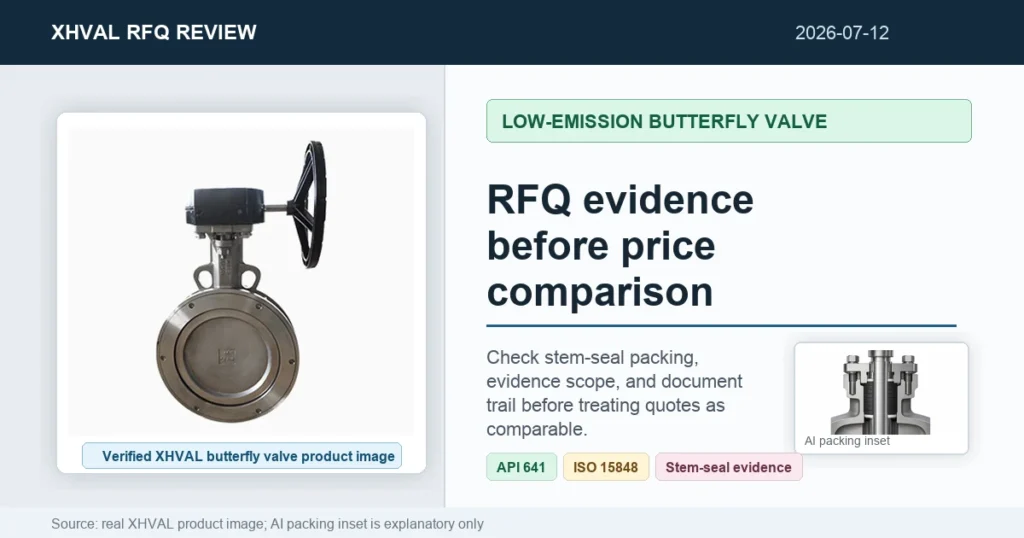
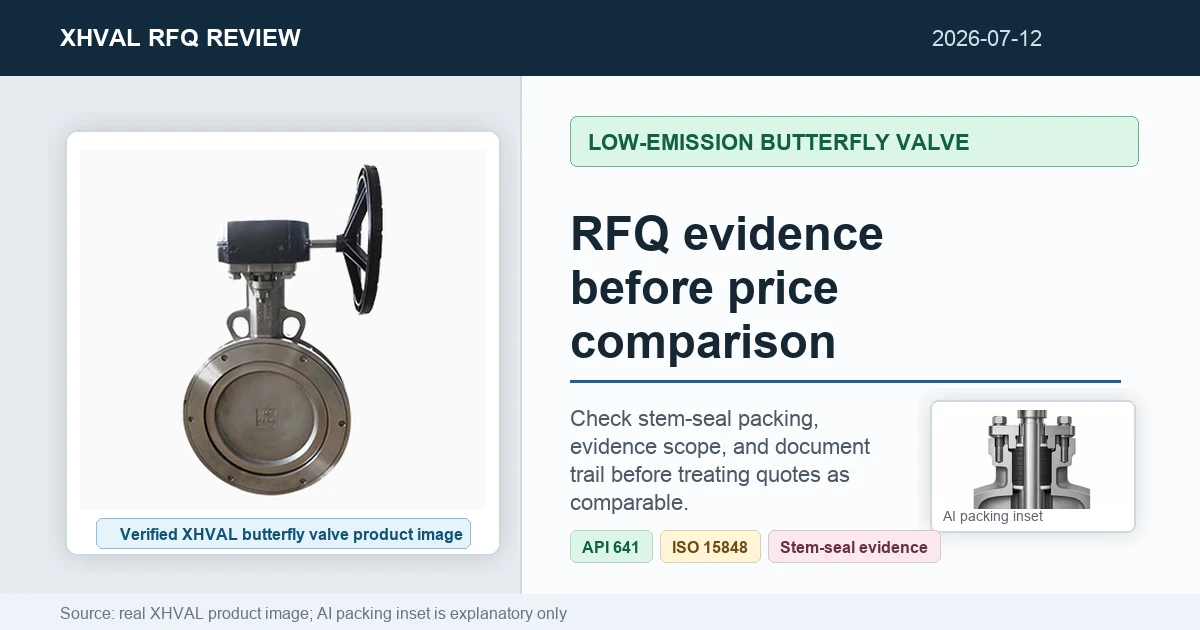
Low-emission valve requirements are no longer only a refinery detail. Methane control, fugitive-emission reviews, and owner document checks are pushing more buyers to ask whether the valve stem seal, packing system, and certificate scope match the duty.
For butterfly valves, the risk is simple: two quotations can both say "low emission", but one quote may only reference a packing material while another may include relevant type-test evidence, production acceptance testing, or project inspection documents.
Quick Verdict
If the RFQ mentions methane, natural gas, VOC service, LNG, refinery, chemical plant, hydrogen blend, or fugitive emission control, do not compare butterfly valve prices until the emission evidence is clear.
At minimum, ask the supplier to state:
| RFQ item | What to confirm | Why it matters |
|---|---|---|
| Butterfly valve design | Concentric, double eccentric, or triple eccentric | Emission evidence should match the offered construction. |
| Standard basis | API 609, project specification, API 641, ISO 15848, or other clause | A valve standard and an emission test standard are not the same thing. |
| Evidence type | Type test, production acceptance test, project inspection, or stem-seal evidence | These are different levels of proof. |
| Temperature range | Ambient, elevated, low temperature, or cycling duty | Packing performance depends on temperature and cycling. |
| Operator package | Gearbox, pneumatic actuator, electric actuator, or bare shaft | Stem loading and torque assumptions affect the final package. |
| Documents | Certificate, test report, drawing, material certificate, deviation list | Buyers need a document trail before approval. |
Why Buyers Are Asking More Questions in 2026
The International Energy Agency's Global Methane Tracker 2026 keeps methane reduction in focus for the energy sector, including measurement, leak detection, and abatement. The U.S. EPA also describes equipment leaks as unintended emissions from components such as connectors, valves, open-ended lines, and pressure relief valves.
That buyer-side pressure does not mean every butterfly valve needs the strictest emission package. It means the RFQ should clearly separate normal isolation duty from low-emission duty.
API 641, ISO 15848, and Stem-Seal Evidence
API 641 is commonly used when buyers discuss fugitive-emission type testing for quarter-turn valves. Butterfly valves, ball valves, and plug valves may all appear in this conversation, but the certificate scope should match the valve type and design being quoted.
ISO 15848 is also common in industrial valve RFQs:
- ISO 15848-1 is used for fugitive-emission type testing classification and qualification.
- ISO 15848-2 is used for production acceptance testing when the project specifies fugitive-emission acceptance.
In 2026, buyers may also see references to ISO 12101:2025 for type testing of valve stem seals. This can be useful supporting evidence for the stem-seal design, but it should not be confused with a complete valve assembly qualification unless the project specification accepts it that way.
What to Ask for a Butterfly Valve Quote
For a low-emission butterfly valve RFQ, avoid vague wording such as "send price for low-emission butterfly valve."
Use a structured request:
Butterfly valve for gas service, API 609 basis, Class 300, metal seated, gear operated. Supplier shall state whether API 641, ISO 15848-1, ISO 15848-2, ISO 12101 stem-seal evidence, or project-specific fugitive-emission evidence is available for the offered valve construction. Quote shall list stem packing material, certificate scope, temperature basis, torque basis, operator responsibility, lead time, and all deviations.
For buyers who are narrowing butterfly valve options, XHVAL's Butterfly Valve page is a useful starting point. When the project is specifically butterfly-valve related, buyers can also review the focused XHVALBUTTERFLY product range. For higher temperature, metal seating, or severe-service isolation, the triple eccentric butterfly valve range is the more relevant path.
Decision Matrix for Quote Comparison
| Buyer requirement | Better supplier answer | Quote risk if unclear |
|---|---|---|
| "Low-emission butterfly valve" | States exact evidence type and certificate scope | Supplier may quote only a generic packing upgrade. |
| "API 641 available" | Maps evidence to the offered butterfly valve design | Evidence may belong to another quarter-turn product. |
| "ISO 15848 required" | Separates type testing from production acceptance testing | Buyer may assume production testing is included when it is not. |
| "Stem-seal evidence accepted" | Explains whether evidence covers only the stem seal or the full valve | Buyer may over-read a component test as a valve qualification. |
| "Actuator package required" | Confirms torque, mounting, and responsibility boundary | Valve and actuator may be quoted under disconnected assumptions. |
RFQ Checklist
Before comparing prices, confirm these seven points:
- Butterfly valve design type and standard basis.
- Pressure class, size, end connection, seat type, and body material.
- Service medium, pressure, temperature, and cycling expectation.
- Fugitive-emission requirement and accepted evidence type.
- Stem packing material, gland design, and any live-loading assumptions.
- Gearbox or actuator scope, torque basis, and ISO 5211 mounting details.
- Required document package and supplier deviation list.
Final Buyer Takeaway
A low-emission butterfly valve RFQ should not only ask for a standard name. It should ask what the evidence actually covers.
That single question helps prevent false low pricing, avoids document disputes after order, and gives the buyer a more reliable basis for comparing technical offers.