

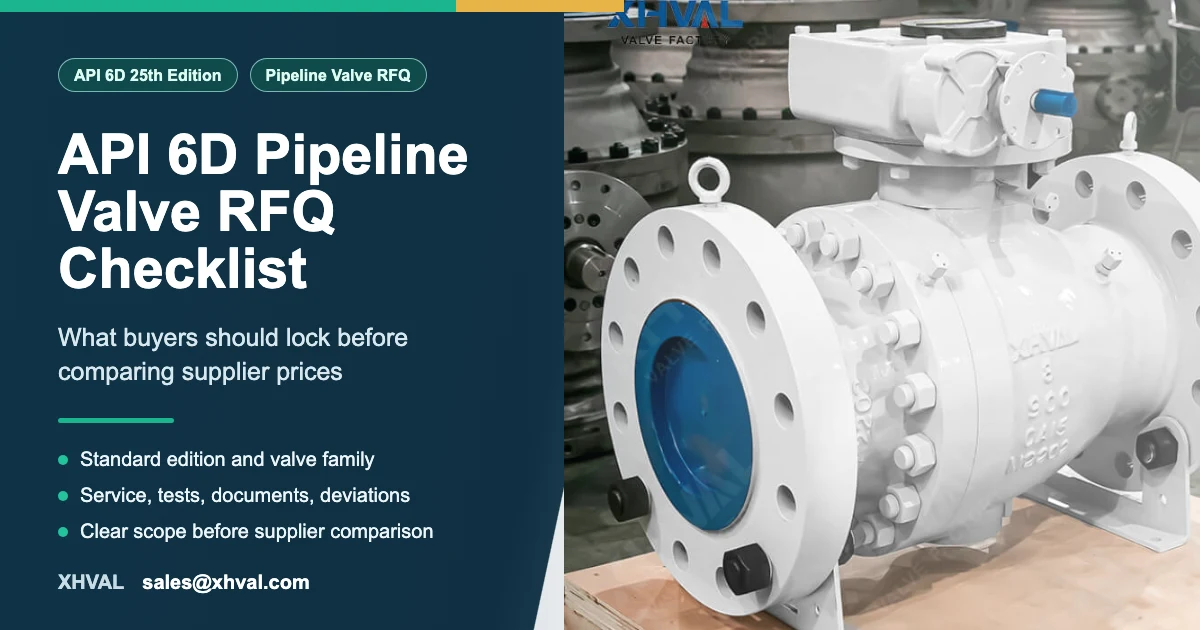
Pipeline valve inquiries are becoming more specific in 2026. A short request such as “API 6D valve, send price” is no longer enough for a reliable quotation. Buyers now need suppliers to confirm the standard edition, valve type, pressure class, service conditions, test scope, and document package before prices can be compared.
The reason is practical: PHMSA confirmed that its API Spec 6D standards update became effective on January 1, 2026, incorporating the 25th edition of API Specification 6D for valves in pipeline safety regulations. For buyers, this does not mean every project suddenly needs a new valve design. It means RFQs should stop treating “API 6D” as a loose label.
Quick Buyer Verdict
If the valve is for pipeline isolation or pipeline-related piping, ask suppliers to state the API 6D edition basis clearly. Then lock the application details before comparing price.
| RFQ point | What the buyer should state | Why it matters |
|---|---|---|
| Standard basis | API Specification 6D, 25th Edition if required by project | Prevents old-edition and new-edition offers being mixed. |
| Valve type | Ball, gate, check, or plug valve | API 6D covers several pipeline valve types, not only ball valves. |
| Service | Natural gas, oil, refined product, water, hydrogen blend, or other medium | Service affects seals, trim, testing, documentation, and review time. |
| Size and class | NPS/DN, ASME class, bore requirement | Drives body design, torque, weight, and actuator sizing. |
| End connection | Flanged, butt-weld, or project-specific ends | End details change manufacturing and inspection requirements. |
| Testing | Pressure test, seat test, NDE, fire-safe, fugitive emission if required | Missing test language creates non-comparable offers. |
| Documents | MTC, drawing, IOM, test report, deviation list | Document scope should be priced before purchase order review. |
What Changed for 2026 RFQs
The important buyer signal is not just that API 6D exists. The important signal is that project teams, pipeline operators, and EPC buyers will be more likely to ask which edition is being quoted.
- API 6D edition not stated.
- Ball valve quoted when the service actually requires a gate, check, or plug valve.
- Floating ball valve offered where trunnion-mounted construction should be reviewed.
- Flanged ends assumed when butt-weld ends are needed.
- Fire-safe, antistatic, NDE, and document requirements left out of the base price.
- Hydrogen-service wording not clarified before supplier selection.
Which Valve Types Should Be Covered
| Valve family | Typical RFQ use | Buyer note |
|---|---|---|
| Ball valve | Main pipeline isolation, piggable line sections, high-flow shutoff | State floating or trunnion, full bore or reduced bore, operator type, and seat requirement. |
| Gate valve | Pipeline isolation where gate design is specified by project | Confirm wedge/slab/expanding gate language and end connection. |
| Check valve | Reverse-flow protection in pipeline or station piping | State swing, axial, dual-plate, non-slam, or project design preference. |
| Plug valve | Isolation or throttling-style project cases where plug design is specified | Confirm lubricated/non-lubricated, pressure class, and operating torque. |
XHVAL product references for this topic include the Cast Steel Trunnion Ball Valve, Full Welded Trunnion Ball Valve, Gate Valve, Check Valve, and Plug Valve pages.
RFQ Wording Buyers Can Use
API 6D pipeline ball valve, NPS 10, Class 600, full bore, trunnion-mounted, flanged RF ends, gear operated, natural gas service. Supplier shall state API 6D edition basis, body/trim/seat materials, fire-safe and antistatic basis, pressure and seat test scope, NDE scope, MTC availability, drawing lead time, IOM availability, delivery time, and any deviation.
Pipeline valve package under API 6D basis: ball valves, check valves, and gate valves for oil and gas service. Supplier shall quote each valve type separately and confirm edition basis, end connection, pressure class, material, test scope, operator, documentation, and deviations.
Do Not Hide Hydrogen or Low-Emission Requirements
If the project involves hydrogen gas, hydrogen blend, methane control, or strict fugitive-emission expectations, these words should be visible in the RFQ. They should not appear late in the technical review.
- Hydrogen gas or hydrogen blend percentage.
- Operating pressure and temperature.
- Material restrictions or project material specification.
- Seal and seat expectations.
- Test and inspection requirements.
- Whether supplier experience references are required.
For low-emission requirements, state whether ISO 15848, API 624, API 641, or a project-specific fugitive-emission clause applies. If the buyer does not know the required class, the RFQ should ask suppliers to identify assumptions instead of silently adding a standard name.
Supplier Comparison Matrix
| Comparison item | Strong supplier response | Weak supplier response |
|---|---|---|
| Standard edition | States API 6D edition and any deviations | Says only “API 6D” with no edition basis |
| Valve design | Confirms bore, construction, seat, seal, operator | Quotes a generic valve model |
| Service review | Addresses medium, pressure, temperature, and special service | Ignores service conditions |
| Testing | Lists pressure, seat, NDE, and optional tests | Says “standard test” only |
| Documents | Lists MTC, drawing, test report, IOM, deviation list | Sends price without document scope |
| Delivery | Gives realistic lead time by valve type | Gives one lead time for all valves |
Final Checklist Before Sending the Inquiry
- API 6D edition basis is stated.
- Valve family is clear: ball, gate, check, or plug.
- Size, pressure class, bore, and end connection are fixed.
- Service medium and operating conditions are listed.
- Body, trim, seat, seal, and operator requirements are visible.
- Fire-safe, antistatic, fugitive-emission, hydrogen, or NDE requirements are not hidden.
- The document package is included before commercial comparison.
The best RFQ is not the longest RFQ. It is the one that removes ambiguity before price comparison. For API 6D pipeline valve packages in 2026, that means standard edition, service duty, valve design, testing, and documentation should be locked before the supplier is asked to compete on price.