

Ball Valve vs Butterfly Valve
A ball valve often fits on/off isolation and a clear flow path. In contrast, a butterfly valve often fits larger lines, tight spaces, lower weight needs, or flow-control duties. However, neither valve wins in every system. Therefore, match the valve to the media, pressure, temperature, pipe size, leakage target, actuator needs, and supplier review.
What Is the Main Difference Between a Ball Valve and a Butterfly Valve?
The main difference sits inside the valve body.
First, a ball valve has a spherical ball with a hole through it. When the bore lines up with the pipe, fluid can pass through. Then, the ball turns 90 degrees and the solid side blocks the flow path. Technical valve references describe this design as a rotary motion valve that uses a ball-shaped disk.
Next, a butterfly valve has a disc on a shaft. The disc turns inside the flow path. In the open position, the disc lines up with the flow direction. In the closed position, it turns against the seat and blocks flow. Technical valve references describe butterfly valves as rotary motion valves that stop, regulate, and start flow.
| Factor | Ball Valve | Butterfly Valve | What to Confirm |
|---|---|---|---|
| Closure element | Bored rotating ball | Rotating disc | Valve design and port type |
| Flow path | Flow passes through the ball bore | Flow passes around the disc | Pressure drop and flow requirement |
| Basic movement | Quarter-turn rotary action | Quarter-turn rotary action | Manual or actuated operation |
| Typical selection focus | Isolation and clear flow path | Compact fit, line size, and flow-control duty | Application conditions and datasheet |
| Main caution | Standard designs usually do not suit precise throttling | The disc stays in the flow path | Control need, media, and seat design |
Ball Valve vs Butterfly Valve Comparison Table
Use the table below as a fast screening tool. After that, check the selected valve design before you buy or request a quote.
| Selection Factor | Ball Valve Direction | Butterfly Valve Direction | What to Confirm |
|---|---|---|---|
| Main service role | Engineers often choose it for on/off isolation. | Engineers often choose it for on/off service and flow-control duty when the design supports it. | Does the valve mainly isolate flow, control flow, or do both? |
| Flow path | The ball bore can give the system a clear flow path. | The disc stays in the flow path. | Does the system need a low-restriction path or a specific flow profile? |
| Throttling/control | Standard ball valves usually do not handle precise throttling well. | Many systems use butterfly valves for flow control when sizing and conditions fit. | Does the valve design support control duty? |
| Line size and space | Check size, support, and cost as the line gets larger. | Consider it when compact fit, weight, or large line size matters. | Confirm pipe size, space, support, and access. |
| Pressure and temperature | Body, seat, trim, rating, and design set the usable range. | Body, seat, disc, stem, rating, and design set the usable range. | Confirm datasheet limits and service conditions. |
| Media compatibility | Match the ball, seat, and body materials to the media. | Match the disc, stem, seat, and body materials to the media. | Check corrosion, solids, slurry, cleaning, and temperature. |
| Actuation | Quarter-turn operation can support manual or automated use. | Quarter-turn operation can support manual or automated use. | Check torque, actuator type, fail position, and control signal. |
| Procurement risk | Do not choose by shutoff need alone. | Do not choose by size or budget alone. | Ask the supplier to review complete operating details. |
How to Choose Between a Ball Valve and a Butterfly Valve
Start With the Valve’s Job
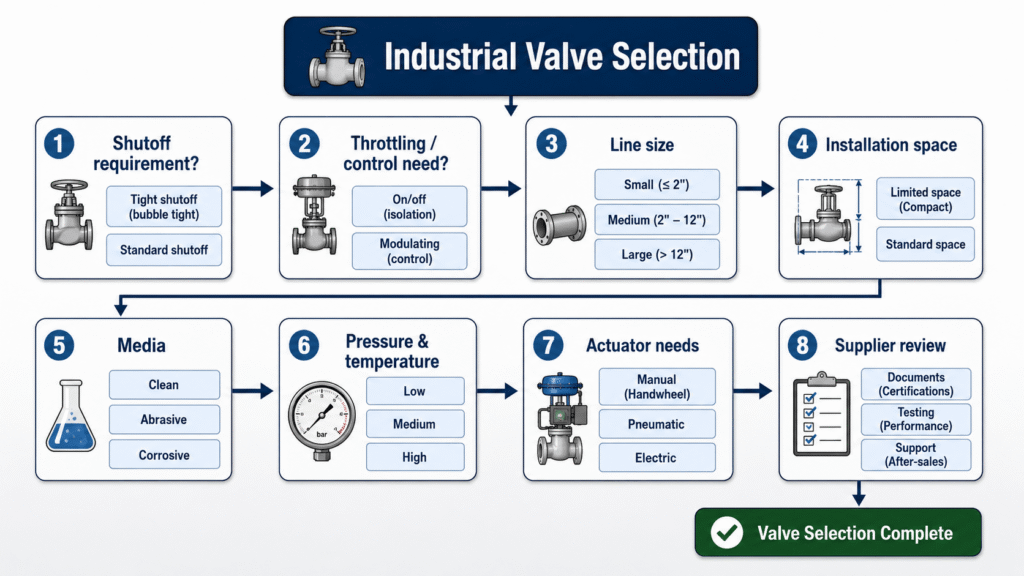
Start with the valve’s main duty. Then, move through service conditions one by one.
For example, an isolation valve in a small clean-water line needs different checks than a control valve in a large process line. In addition, corrosive media, solids, steam, gas, and frequent operation can change the best shortlist.
Compare Service Conditions Before You Shortlist
| Application Condition | Consider a Ball Valve When… | Consider a Butterfly Valve When… | Ask for Supplier Review When… |
|---|---|---|---|
| Primary duty | The valve mainly opens or closes flow. | The valve may need on/off service and flow control. | The valve must control flow often or accurately. |
| Flow path | The system benefits from a clearer bore. | A disc in the flow path will not create a problem. | Pressure drop or flow behavior matters. |
| Line size | The valve size and support remain practical. | Large line size, compact layout, or weight matters. | Handling, support, actuator torque, or access feels uncertain. |
| Throttling | The valve needs only limited control, or the project specifies a control-style ball valve. | The valve needs flow control and the butterfly design matches the system. | Control stability, pressure drop, or frequent operation matters. |
| Media | The ball, body, and seat materials match the media. | The disc, stem, seat, and body materials match the media. | Media is corrosive, abrasive, sticky, sanitary, or contains solids. |
| Pressure and temperature | The selected design carries the required rating. | The selected design carries the required rating. | Conditions sit near the rating limit or change during operation. |
| Maintenance | The design supports the inspection or service plan. | The access, cleaning, and seat service approach fit the layout. | Downtime, cleaning, or field service matters. |
| Procurement | The specification clearly points to isolation duty. | The project needs compact fit, large-size practicality, or control duty. | The RFQ misses media, rating, material, actuator, or document details. |
Choose a Ball Valve When…
Choose a ball valve when the system mainly needs on/off isolation and the selected design matches the media, pressure, temperature, and leakage target.
Also, consider a ball valve when a clear flow path helps the system. Many buyers also value the simple quarter-turn operation. However, do not treat every ball valve as a control valve.
Standard ball valves usually do not suit precise throttling. If the application needs control service, ask whether the design uses a standard ball, V-port ball, segmented ball, or another control-focused setup.
- The main task is to open or close flow.
- A clear flow path helps the system.
- You need straightforward quarter-turn operation.
- You have checked actuator torque.
- Seat and body materials fit the media.
- The datasheet matches the required pressure and temperature range.
Choose a Butterfly Valve When…
Choose a butterfly valve when line size, compact fit, weight, or flow-control duty matters and the selected design matches the service.
In addition, butterfly valves often help when the project needs a compact quarter-turn valve in a larger line. Still, the disc stays in the flow path, so you should check flow behavior, pressure drop, media, seat material, and actuator requirements before ordering.
Use general butterfly-valve advantages as selection clues, not final proof. Therefore, confirm the disc, seat, stem, body material, actuator, pressure drop, media conditions, and datasheet limits.
- The system uses a larger line size where compact geometry matters.
- Space in the layout is tight.
- Weight or support requirements affect the layout.
- The application needs on/off operation plus flow-control duty.
- A rotating disc in the flow path will not create a problem.
- Body, disc, stem, and seat materials match the media.
- The selected design meets the pressure, temperature, and leakage target.
Ask a Supplier for Review When Conditions Are Unclear
A generic comparison table cannot answer every selection question. When the conditions are unclear, ask the supplier or engineer to review the application before you commit to a valve type.
- The media is corrosive, abrasive, sticky, sanitary, or contains solids.
- Pressure or temperature sits near the upper range of the selected design.
- Project approval requires a strict leakage target.
- Frequent control or throttling will occur.
- The system needs an actuator, positioner, fail-safe position, or remote operation.
- Cleaning, draining, or trapped media may affect operation.
- The valve must fit an existing flange, actuator, pipe layout, or maintenance space.
- The buyer needs documents, tests, or compliance records before approval.
As a rule, match the valve design to the operating conditions. Do not choose by valve family name alone.
Selection Risks When You Choose the Wrong Valve
Review These Risks Before You Choose by Price or Size
A poor valve choice can create installation, operation, or approval problems. The points below are review items, not failure predictions.
| Selection Factor | Possible Risk If You Ignore It | What to Check Before RFQ |
|---|---|---|
| Main valve duty | An isolation-focused choice may not handle control duty well. | On/off duty, throttling duty, control need, cycle frequency |
| Seat and material choice | Media, temperature, or cleaning needs may not match the materials. | Body material, seat material, disc/ball material, stem material |
| Pressure and temperature | The selected design may fall outside the intended service range. | Pressure class, temperature range, pressure drop, service variation |
| Flow path | The valve may change flow behavior near instruments or equipment. | Bore size, disc position, pressure drop, upstream/downstream layout |
| Actuation | The actuator may not match the valve torque or control need. | Operating torque, actuator type, fail position, control signal |
| Installation space | The valve, handle, actuator, or service area may not fit. | Face-to-face space, handle clearance, actuator clearance, access |
| Media condition | Solids, slurry, corrosion, or sticky media may affect operation. | Media type, viscosity, solids content, corrosion risk, cleaning need |
| Procurement details | The supplier may lack enough data to recommend the right option. | Full RFQ checklist, drawings, documents, quantity, destination |
Material choice needs special care. For example, seat material can limit the service conditions for a valve. Therefore, match body, seat, disc, ball, and stem materials to the actual media before you order.
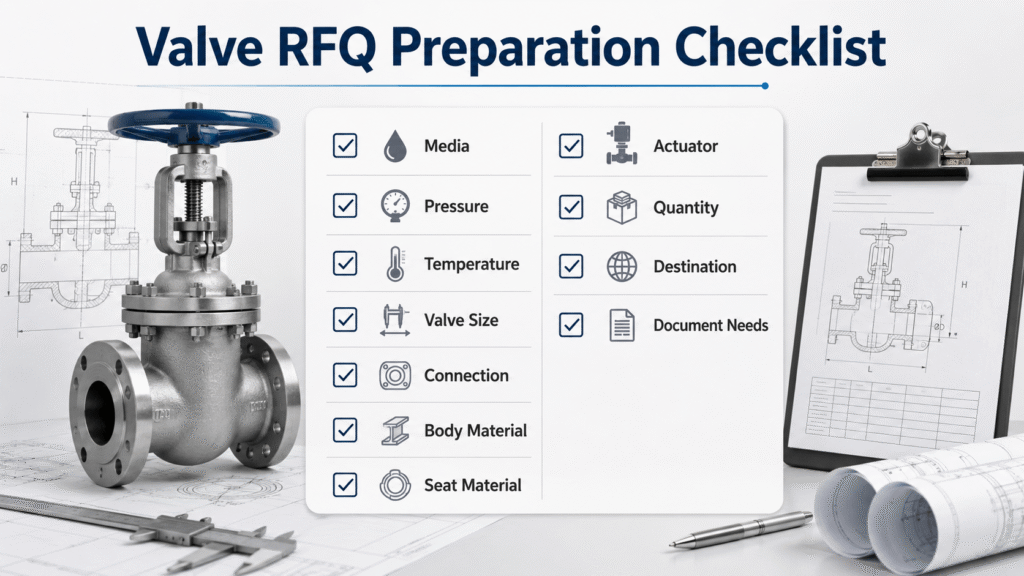
What to Include in a Valve RFQ
Prepare These Details Before You Ask for a Quote
A complete RFQ saves time because it gives the supplier enough detail to review the application. It also reduces the risk of choosing a valve type before the service conditions are clear.
- Valve type preference, if known: ball valve, butterfly valve, or open for review
- Application or process description
- Media type
- Media condition: clean, corrosive, abrasive, viscous, slurry, gas, steam, water, or other
- Operating pressure
- Operating temperature
- Pipe size or valve size
- Connection type
- Body material preference
- Seat or sealing material preference, if known
- Required operation: manual, pneumatic, electric, hydraulic, or other
- Control need: on/off, throttling, modulating, emergency shutoff, or isolation
- Leakage target or shutoff requirement
- Cycle frequency
- Installation position and space limits
- Quantity
- Destination country or delivery location
- Required drawings, datasheets, test documents, or certificates
- Any project specification or customer drawing
If You Are Unsure, Send the Operating Conditions First
When you are not sure which valve fits, send the operating conditions first. Then, the supplier can review the service and suggest a valve type, size, material, and actuator direction.
FAQ: Ball Valve vs Butterfly Valve
Which is better, a ball valve or a butterfly valve?
Neither valve is always better. A ball valve often fits on/off isolation and a clear flow path. In contrast, a butterfly valve often fits larger lines, tight spaces, lower weight needs, or flow-control duty. However, the better choice depends on media, pressure, temperature, line size, leakage target, actuator needs, and maintenance access.
What are the main differences between ball valves and butterfly valves?
A ball valve uses a bored rotating ball to open or close the flow path. In contrast, a butterfly valve uses a rotating disc in the flow path. Therefore, this difference affects flow path, pressure drop, shutoff use, throttling use, installation size, and maintenance planning.
What are the disadvantages of butterfly valves?
Potential disadvantages depend on the valve design and service. Because the disc stays in the flow path, review pressure drop, flow behavior, cleaning access, solids or slurry service, leakage target, and seat or disc material fit. Also, do not assume one butterfly valve design suits every media or pressure condition.
What are two disadvantages of ball valves?
Two common limits are throttling suitability and larger-size practicality. First, a standard ball valve usually does not suit precise throttling. In addition, larger lines require checks for space, actuator torque, weight, and total cost against the selected design and project conditions.
Can ball valves and butterfly valves handle throttling?
They can support flow control only when the valve design and system conditions match the duty. For example, many systems use butterfly valves for throttling. However, standard ball valves usually fit on/off service better; for control duty, ask for a control-focused ball valve design when the project requires it.
When should I choose a ball valve?
Choose a ball valve when the main need is on/off isolation, a clear flow path, and quick quarter-turn operation. Before ordering, confirm that the selected valve materials and ratings match the media, pressure, temperature, and leakage target.
When should I choose a butterfly valve?
Choose a butterfly valve when compact fit, larger line size, weight, or flow-control duty matters. Before ordering, confirm pressure and temperature ratings, seat and disc materials, media fit, actuator needs, leakage target, and maintenance access.
What should I include in a valve RFQ?
Include media, pressure, temperature, valve size, connection type, material preference, control duty, actuator requirement, leakage target, quantity, destination, and required documents. If you are unsure which valve type fits, describe the application conditions and ask the supplier to review both options.
Sources Referenced
- Engineering Library / DOE Fundamentals Handbook valve reference
- GlobalSpec butterfly valves selection guide
- Spirax Sarco control valves reference
- EngineeringToolBox ball valve flow coefficients note
Need Help Reviewing Valve Selection Details?
Need help choosing between a ball valve and a butterfly valve? Prepare your media, pressure, temperature, line size, connection type, material preference, actuator needs, quantity, destination, and document requirements. Then, share those details for application review before a quotation or valve recommendation.