
Which Valves Do Oil and Gas Systems Use?
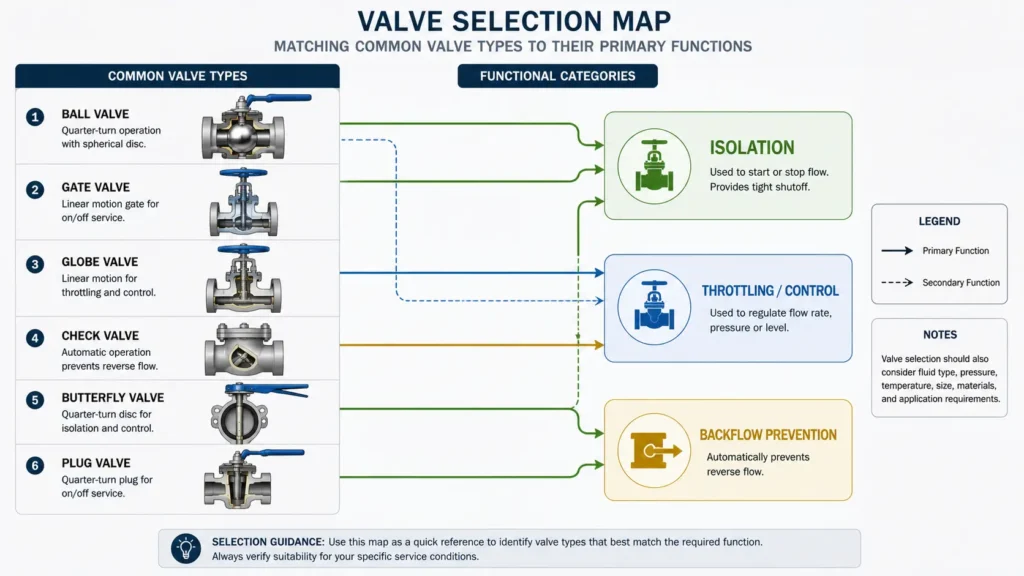
Oil and gas systems commonly use ball valves, gate valves, globe valves, check valves, butterfly valves, and plug valves. Teams choose these valve families for isolation, flow regulation, backflow prevention, and process control. However, the final choice depends on the medium, pressure and temperature range, materials, connection type, operation method, documents, and project requirements.
Common Valve Types and What They Do
Different valve designs solve different flow-control problems. For oil and gas buyers, the goal is not just to name a valve type. Instead, buyers need to match the valve’s function to the system’s operating conditions.
| Valve type | Common function | Where buyers often consider it | What to confirm before selection |
|---|---|---|---|
| Ball valve | Fast on/off isolation | Lines that need quarter-turn operation and shutoff control | Media, pressure and temperature rating, seat/seal material, end connection, operation method |
| Gate valve | Full-open or full-closed isolation | Lines that need low flow restriction when the valve stays open | Whether the system needs isolation only, not continuous throttling |
| Globe valve | Flow regulation or throttling | Lines that need controlled flow adjustment | Pressure drop, flow-control need, media, trim, and seat details |
| Check valve | Backflow prevention | Lines that need reverse-flow control | Flow direction, cracking pressure, installation position, maintenance access |
| Butterfly valve | Quarter-turn flow control or isolation | Larger lines or layouts that benefit from compact valve geometry | Disc/seat material, service conditions, connection style, shutoff requirement |
| Plug valve | Quarter-turn flow control or isolation | Systems that may use a rotating plug design | Media, lubrication/sealing design, operating torque, maintenance needs |
Valve function drives many selection decisions. For example, a useful reference on valve classification explains that teams may choose valves to start or stop flow, throttle flow, regulate pressure or temperature, redirect flow, or prevent reverse flow. See this valve type and function guide for general technical background.
Ball Valves
Ball valves use a rotating ball with a bore through the center. When the bore aligns with the flow path, the valve opens. When the ball turns, the valve closes the flow path.
In practice, buyers often discuss ball valves for on/off service because they open and close with a quarter-turn motion. However, they do not automatically fit every application. Also, buyers still need to confirm the medium, operating range, sealing design, end connection, and operation method.
Selection reminder: Do not choose a ball valve only because it appears often in oil and gas discussions. First, confirm whether the line needs isolation, frequent operation, remote operation, or another control function.
Gate Valves
In practice, gate valves use a gate or wedge that moves up and down to open or close the flow path. Because of this design, buyers usually discuss them for full-open or full-closed isolation.
However, gate valves do not suit continuous throttling in many applications. In addition, partially open operation can make flow control difficult and may increase wear.
Selection reminder: Consider a gate valve when the application needs open/close isolation. If the system needs flow regulation, ask the supplier or project engineer to review another valve family.
Globe Valves
For example, globe valves often enter the discussion when a line needs flow regulation. Their internal flow path and movable plug allow more controlled adjustment than many isolation-first designs.
However, this does not make every globe valve suitable for every oil or gas line. Globe valves can create pressure drop, so the project team should review media, control range, trim, seat, end connection, and maintenance access.
Selection reminder: Use globe valves as a starting point when the system needs throttling or regulated flow. Then, confirm whether the specific valve design matches the project conditions.
Check Valves
Similarly, check valves help prevent reverse flow. They open when forward flow meets the required condition and close when the line moves toward reverse flow.
In oil and gas systems, backflow control can matter a great deal. Therefore, the project team should review the exact check valve design, installation direction, valve position, flow rate, pressure conditions, and maintenance access.
Selection reminder: Choose check valves by flow direction, installation position, and operating conditions—not by valve name alone.
Butterfly Valves
Butterfly valves use a rotating disc to open, close, or regulate flow. Buyers often discuss them when a compact quarter-turn valve can help with layout or larger-line planning.
Still, the project team should confirm the shutoff requirement, disc and seat materials, service conditions, pressure and temperature range, connection style, and operation method before shortlisting a butterfly valve.
Selection reminder: Butterfly valves can fit some layouts, but buyers should confirm sealing needs and operating conditions before treating them as a default choice.
Plug Valves
Plug valves use a rotating plug to control flow. In some cases, buyers may discuss them for on/off service or flow-direction control, depending on the design.
Because plug valve designs can differ, buyers should confirm media, torque, lubrication or sealing design, operating frequency, maintenance needs, and document requirements before selection.
Selection reminder: Treat plug valves as a design-specific option. Also, ask for product details that match the actual medium and operating conditions.
Choose by Function Before Choosing by Valve Name
In practice, a practical selection process starts with the function. Also, the same oil and gas project may need different valves for isolation, flow regulation, non-return protection, and automated operation.
| Required function | Valve families to discuss | Key questions to ask | Risk to watch |
|---|---|---|---|
| Isolation / shutoff | Ball, gate, butterfly, plug | Does the line need full-open/full-closed service? How often will operators cycle it? | The team may miss a throttling need if it chooses only for shutoff. |
| Throttling / flow regulation | Globe, some butterfly or control-valve designs | How much control does the process need? What pressure drop can the system accept? | The system may suffer poor control or avoidable pressure loss. |
| Backflow prevention | Check valves | Which way does the flow move? Which installation position does the project require? | The design may fail to address reverse-flow risk. |
| Automated operation | Actuated valve designs | Does the site need manual, pneumatic, electric, or hydraulic operation? What fail position does it need? | The valve may not integrate with the control system. |
| Document-driven selection | Any project-required valve type | Which standards, drawings, inspection records, or certificates does the buyer need? | A valve may pass a basic technical review but still fail a document review. |
The main point is simple: start with the job the valve must do. After that, buyers and engineers can review the valve family, material, size, connection, operation method, and documents more accurately.
Isolation and On/Off Service
For isolation, buyers often compare ball, gate, butterfly, and plug valves. However, the right choice depends on more than open/close function. Operating frequency, shutoff need, line size, end connection, and maintenance access all matter.
For example, a valve that operators rarely open may need a different design from a valve that cycles often. Also, a manual valve may require different planning from an actuated valve that connects to a control system.
Throttling or Flow Regulation
When a line needs flow adjustment, buyers should ask whether the valve design supports throttling or control service. Globe valves often enter flow-regulation discussions, while gate valves usually fit isolation discussions better.
Even so, treat that guidance as a starting point, not a final rule. The supplier and project engineer should confirm whether the specific valve design, trim, seat, and operating range fit the application.
Backflow Prevention
Check valves help the system reduce reverse-flow risk. Therefore, the valve needs to match flow direction, installation position, pressure conditions, and maintenance access.
A check valve can perform poorly when the team ignores flow conditions. For that reason, the RFQ should state the flow direction and relevant operating details clearly.
Automated or Process Control Needs
Some oil and gas systems use manual valves. Others need pneumatic, electric, hydraulic, or control-linked operation. Because operation method affects valve selection, installation, maintenance, and control-system integration, buyers should define it early.
In addition, buyers should specify remote operation needs, fail-open or fail-closed behavior, position feedback, and control-system requirements before quotation.
Operating Conditions That Affect Valve Choice
However, a valve type gives only part of the answer. The same valve family can have different materials, seats, seals, end connections, and operation options.
As a result, engineers should review the valve’s materials against the medium and the mechanical design before they shortlist a product. See the Engineering ToolBox valve selection guide for general selection background.
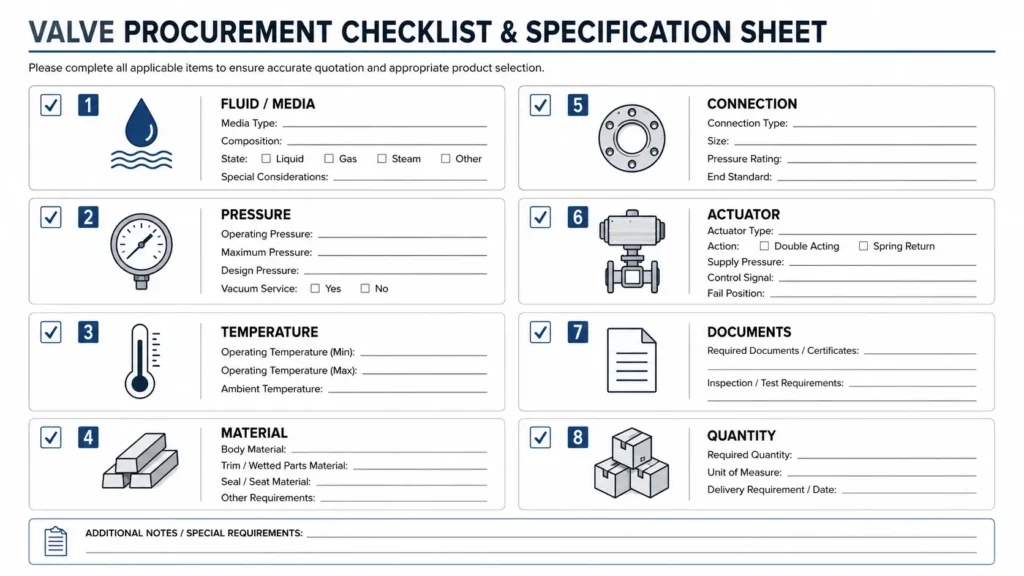
Next, prepare these details before requesting a quote:
| Selection factor | What buyers should prepare | Why it matters |
|---|---|---|
| Media / fluid | Oil, gas, condensate, water, chemical, steam, slurry, or mixed media | Media affects body material, seat/seal choice, and document needs. |
| Pressure range | Normal and maximum operating pressure | The proposed valve must match the required pressure rating. |
| Temperature range | Normal and maximum operating temperature | Temperature affects material, seat, seal, and rating decisions. |
| Material requirement | Body, trim, seat, seal, gasket, or packing preference | Material choice should match the media and project requirements. |
| Valve size | Nominal size and pipe schedule if available | Size affects flow, connection, installation, and quotation accuracy. |
| End connection | Flanged, threaded, socket weld, butt weld, wafer, lug, or other | Connection style must match the piping system. |
| Operation method | Manual, gear, pneumatic, electric, hydraulic, or other | Operation method affects design, torque, installation, and control. |
| Flow direction | One-way or two-way flow, reverse-flow risk | Flow direction matters for check valves and other directional designs. |
| Maintenance access | Space, removal access, operating access | Maintenance constraints can affect valve type and body design. |
| Documents | Drawings, datasheets, certificates, inspection reports, test records | Procurement teams may need project-specific documents before approval. |
Media, Materials, and Sealing Requirements
First, start with the medium. Oil, gas, steam, water, chemical service, and mixed media can each raise different selection questions.
Do not assume one material or seal type fits all oil and gas applications. Instead, describe the medium and ask the supplier to review body material, trim, seat, seal, gasket, and packing options for the project.
Pressure and Temperature Range
Pressure and temperature details work best as ranges, not vague labels such as “high pressure” or “hot service.” A better RFQ states expected operating pressure, maximum pressure, normal temperature, maximum temperature, and any upset conditions that need review.
Then, the supplier can compare those conditions with the proposed valve’s rating and documents.
Size, End Connection, and Flow Direction
Valve size and end connection determine whether the valve can fit the piping layout. If available, send the nominal pipe size, pipe schedule, flange requirement, weld requirement, or threaded connection detail.
Also, state the flow direction. Some valves use directional designs, and check valves depend on forward and reverse flow behavior.
Operation Method, Access, and Maintenance Context
Define the operation method early. A valve that operators can turn easily in a workshop may not work well in a remote, elevated, or automated site location.
Therefore, provide information about manual or automated operation, available power or air supply, installation space, maintenance access, and any position feedback or fail-position needs.
Application Context: Production, Pipeline, Refining, and Utility Systems
Oil and gas is not a single operating environment. Production, pipeline transportation, refining, storage, and utility systems can each raise different selection questions.
This section does not assign one valve type to every context. Instead, it shows how the application changes the questions buyers should ask.
| Application context | Typical flow-control need | Valve decision questions | Documents to confirm |
|---|---|---|---|
| Production or processing area | Isolation, regulation, non-return protection | What medium will the valve handle? Does the line involve gas, liquid, water, or mixed phases? | Datasheet, drawing, pressure/temperature rating, material details |
| Pipeline transportation | Isolation, sectional control, backflow prevention | What line size, connection type, operating range, and shutoff need does the project specify? | Project requirement, valve drawing, inspection/test documents |
| Refining or process units | Flow regulation, isolation, process control | Does the line need throttling? Which media and temperature conditions apply? | Datasheet, material documents, inspection requirements |
| Storage or terminal operations | Isolation, loading/unloading control, reverse-flow prevention | How often will operators cycle the valve? Which connection needs apply? | Valve requirement, installation details, inspection records |
| Utility or support systems | Water, steam, air, or auxiliary service control | Does the line support utility service or a process-critical system? | Utility requirement, valve data, installation details |
Why Application Context Changes the Questions
A buyer may ask, “Which valve does an oil and gas system use?” However, a better technical question is, “What function does this valve need to perform in this specific system?”
The answer may change when the valve handles isolation, throttling, backflow prevention, manual operation, automated control, or document-controlled procurement.
Decision Questions by Context
Before shortlisting a valve, ask these questions:
- Which medium will pass through the valve?
- Does the valve mainly handle isolation, regulation, non-return protection, or automation?
- Which pressure and temperature range should the supplier review?
- What material or corrosion requirements does the project specify?
- Which size and end connection does the piping layout need?
- Does the site need manual, pneumatic, electric, hydraulic, or control-linked operation?
- Which documents does procurement need for review?
- Which standards or customer requirements apply to the project?
These questions help prevent a common problem: choosing a valve by name before the team understands the operating conditions.
Standards, Certifications, and Documents to Confirm
Oil and gas projects often set standards, customer requirements, inspection steps, and certificate requests. Therefore, buyers should confirm those requirements before purchase.
For example, API describes Spec 6D as a specification for valves that defines manufacturing requirements. That makes API Spec 6D relevant as a standards reference in some valve-procurement discussions. However, it does not prove that any specific supplier or product complies.
Standards and document caution: Do not rely on broad claims such as “API compliant,” “certified,” “fire-safe,” “sour-service suitable,” or “meets international standards” unless the supplier provides current, product-specific evidence that matches the project scope.
For buyer-side standard-scope questions, XHVAL also provides an API 622 buyer checklist article. Use that type of resource for question planning, not as proof that every product meets a standard.
Confirm the Project-Required Standard
Ask the project engineer, end user, or buying specification which standards apply. The required standard may depend on the valve type, service, country, customer requirement, and document package.
Useful questions include:
- Which standard or customer requirement applies?
- Does the requirement cover valve design, testing, material, fugitive-emission performance, fire test, or another scope?
- Can the supplier’s document match the exact product, size range, pressure class, and valve series in the quote?
- Can the supplier show a current certificate when the buyer requires one?
- Does the project require third-party inspection?
- Should the document package include material certificates, pressure test records, or inspection reports?
Ask for Documents That Match the Product and Project
Depending on the project, a document list may include:
- product datasheet;
- technical drawing;
- material certificate;
- pressure test or inspection document;
- certificate scope where applicable;
- packing, seat, seal, or trim information;
- operation details if the valve uses an actuator;
- project-specific compliance statement if the buyer requires one.
Most importantly, treat documents as product-specific and project-specific. A general website certificate should not stand in for proof on every valve, size, material, pressure class, or service condition.
What to Prepare Before Requesting an Oil and Gas Valve Quote
In practice, a complete RFQ helps the supplier review the application and respond with more relevant valve options. Therefore, buyers should prepare as many details as possible before contacting a supplier.
| RFQ item | What to include |
|---|---|
| Valve function | Isolation, throttling, backflow prevention, automation, or other |
| Valve type if known | Ball, gate, globe, check, butterfly, plug, or unsure |
| Medium | Oil, gas, water, steam, condensate, chemical, slurry, mixed media |
| Pressure range | Normal and maximum operating pressure |
| Temperature range | Normal and maximum operating temperature |
| Valve size | Nominal size and pipe details if available |
| End connection | Flanged, threaded, socket weld, butt weld, wafer, lug, or other |
| Material preference | Body, trim, seat, seal, gasket, or packing requirement |
| Operation method | Manual, gear, pneumatic, electric, hydraulic, or control-linked |
| Quantity | Prototype, single purchase, project quantity, or repeat order estimate |
| Drawings/requirements | P&ID, technical drawing, datasheet, or project requirement |
| Required documents | Certificates, inspection records, test reports, material documents |
| Delivery destination | Country, port, site location, or shipping requirement |

RFQ Details to Collect
Also, a strong RFQ does not need to be perfect. It needs to show the supplier what to review.
At minimum, include the valve function, medium, pressure and temperature range, size, connection type, quantity, and any required documents. If you do not know the valve type, explain the function and operating conditions instead of guessing.
How to Handle Uncertain Applications
If you do not know which valve type to choose, avoid sending only a short request such as “Please quote an oil and gas valve.” Instead, give the supplier enough context to review the application.
“We need a valve for isolation / throttling / backflow prevention. Medium: ____. Expected pressure range: ____. Normal and maximum temperature: ____. Required size and connection: ____. Please review possible valve options and tell us what documents are available for review.”
This approach gives the supplier a clearer starting point. At the same time, it avoids forcing the buyer to guess a valve type before the technical details are clear.
How to Evaluate Supplier Claims Before Purchase
Procurement teams often compare suppliers by price, availability, documents, and technical fit. However, valve claims can sound similar even when the supporting evidence differs.
Next, use the checklist below to review high-risk claims.
| Supplier says | Why the claim may be unclear | Safer follow-up question | Evidence to request |
|---|---|---|---|
| “Certified valve” | The certificate scope may not match the quoted product | Which certificate applies to this exact valve series and size? | Current certificate and scope page |
| “API compliant” | API scope may depend on product, standard, and edition | Which API standard and edition apply? | Product-specific compliance evidence |
| “Suitable for high pressure” | “High pressure” does not define a specification | Which pressure rating and test record apply? | Datasheet, rating, pressure test document |
| “Good for corrosive media” | Media compatibility depends on material and chemistry | Which material and seal do you recommend for this medium? | Material data, engineering review, certificate if needed |
| “Fire-safe” | Fire test claims need specific evidence | Which fire test standard and product scope apply? | Fire-test certificate or report |
| “Fast delivery” | Timing depends on stock, production, and logistics | What lead time can you confirm for this order? | Written quotation or sales confirmation |
| “Long service life” | Service life depends on conditions and maintenance | Which operating conditions and maintenance assumptions support the claim? | Datasheet, maintenance guidance, warranty terms if available |
Claims That Need Evidence
Ask for evidence when a claim involves:
- certificates;
- standards compliance;
- pressure or temperature ratings;
- fire-safe or fugitive-emission performance;
- sour-service or corrosive-media suitability;
- material compatibility;
- inspection or testing;
- lead time;
- warranty;
- production capacity;
- customer cases or project references.
These claims are not automatically wrong. They simply need the right proof before buyers use them in procurement decisions.
Safer Follow-Up Questions to Ask
Use practical, specific questions:
- Does this document apply to the quoted valve model?
- Does it cover the required size, pressure class, and material?
- Can the supplier show a current certificate?
- Does this test report cover this product, or does it cover a different product family?
- Can the supplier provide a drawing and datasheet before order approval?
- Which documents will the supplier include with shipment?
- What information do you need from us before reviewing valve options?
In short, these questions move the conversation from broad marketing language to verifiable project details.
When to Contact XHVAL About Oil and Gas Valve Requirements
Finally, XHVAL’s website lists industrial valve categories including ball valves, gate valves, globe valves, butterfly valves, check valves, plug valves, strainers, and cast iron valves. It also lists oil-and-gas-related industries among its served markets. Treat this as a company-site category statement, not as a product-specific suitability, certification, or standards-compliance claim.
For an oil and gas valve inquiry, contact XHVAL with the application details rather than only the valve name. Include the function, medium, pressure and temperature range, valve size, connection type, material preference, operation needs, quantity, drawings or project requirements, and required documents. You can also review XHVAL’s industrial valve product categories before preparing the RFQ.
Need help shortlisting a valve type for an oil and gas application? Send XHVAL your valve function, operating conditions, size, connection type, material requirements, quantity, and document needs so the team can review the inquiry and prepare a more relevant quotation.
FAQs About Valves in the Oil and Gas Industry
Which valves do oil and gas systems use?
In most discussions, common valve families include ball valves, gate valves, globe valves, check valves, butterfly valves, and plug valves. However, the right choice depends on the valve’s job, the medium, pressure and temperature range, material requirements, connection type, operation method, and project documents.
Which oil and gas valve types do buyers discuss most often?
Usually, buyers discuss ball, gate, globe, check, butterfly, and plug valves first. These valve families support different functions, including isolation, flow regulation, backflow prevention, and quarter-turn operation. Still, a buyer should confirm the exact design and operating conditions before purchase.
How do ball, gate, globe, check, butterfly, and plug valves differ?
In simple terms, ball valves and plug valves use rotating closure elements. Gate valves use a moving gate for open/close service. Globe valves often support flow regulation. Similarly, check valves help prevent reverse flow. Butterfly valves use a rotating disc and often enter discussions where compact quarter-turn operation helps.
Which valve should buyers discuss for isolation, throttling, flow control, or backflow prevention?
For isolation, buyers often compare ball, gate, butterfly, and plug valves. When the system needs throttling or flow regulation, they often discuss globe valves and control-oriented designs. For backflow prevention, they usually review check valves. Finally, the project team should confirm the choice through system design, operating conditions, and project requirements.
Which operating conditions affect oil and gas valve selection?
Key conditions include the medium, pressure range, temperature range, material requirements, valve size, end connection, sealing design, operation method, flow direction, maintenance access, and required documents. Therefore, buyers should not select a valve by type alone.
What should I prepare before requesting an oil and gas valve quote?
First, prepare the valve function, valve type if known, medium, pressure and temperature range, valve size, end connection, material preference, operation needs, quantity, drawings or project requirements, required standards or documents, and delivery destination. If you do not know the valve type, describe the function and operating conditions.
Which standards or documents should I confirm before purchase?
First, confirm the project-required standards and documents with the project engineer, end user, or buying requirement. Then, ask the supplier for product-specific drawings, datasheets, material documents, inspection records, test reports, and certificate scope where applicable. Do not assume a general certificate covers every product or service condition.