

Is Brass or Stainless Steel Better for Valves?
Neither brass nor stainless steel works best for every valve. Instead, match the material to the media, corrosion risk, pressure, temperature, valve type, seat and seal materials, connection, and document needs. First, confirm the service conditions. Then compare the exact brass alloy or stainless grade with the valve datasheet before you request a quote.
Brass vs Stainless Steel Valves: Quick Comparison
First, use this table as a quick screen. Then check the exact valve data before you choose a material.
| Selection factor | Brass review note | Stainless steel review note | What to confirm before choosing |
|---|---|---|---|
| Material family | Brass uses copper and zinc. Its composition changes its properties. | Stainless steel uses chromium. The chromium helps form a protective surface film. | Exact alloy or grade, valve design, and supplier datasheet. |
| Corrosion exposure | Some brass alloys can corrode or lose zinc in certain water or chemical conditions. | Stainless steel resists corrosion, but chlorides, acids, or crevice areas can still create risk. | Media, water chemistry, chloride exposure, pH, temperature, and grade or alloy. |
| Pressure and temperature | Do not judge pressure or temperature fit by body material alone. | Do not judge pressure or temperature fit by body material alone. | Full valve rating, lowest-rated component, seats, seals, and manufacturer data. |
| Budget | Budget matters, but it cannot outweigh media, corrosion risk, valve rating, or document needs. | Next, review stainless steel when corrosion risk, document needs, or service conditions raise project risk. | Budget range, operating risk, required documents, and datasheet limits. |
| Procurement review | Use brass only after the project team confirms the service conditions. | Use stainless steel review when grade, corrosion, or document checks need closer control. | Valve type, size, media, pressure, temperature, quantity, connection, and required documents. |
What Are Brass and Stainless Steel?
Before you choose a valve body, separate the material family from the exact product spec. Both names cover groups of alloys. Therefore, check the grade, composition, valve design, and service conditions.
Brass basics
In short, brass is a copper-zinc alloy family. The Copper Development Association describes brasses as copper-zinc alloys whose structure and properties depend on zinc content.
Therefore, treat brass as a material family, not as one universal spec. Ask the supplier to confirm the brass alloy, valve rating, media fit, and any required compliance document before you decide.
Also, review brass for a valve or fitting project only when the selected alloy, valve design, service conditions, and document needs all fit. For product navigation, see XHVAL’s brass ball valve page. Use that page as a navigation path only; do not treat it as proof of product-specific fit without datasheet or certification review.
Stainless steel basics
In short, stainless steel is a family of chromium-containing steels. worldstainless explains that stainless steel gains corrosion resistance from a passive, chromium-rich oxide film on the steel surface. However, corrosion can still occur in specific environments.
For this reason, review stainless steel by grade and environment. Do not say “use stainless steel” until the grade, valve design, and service conditions match the application.
In addition, check the exact media, temperature, chloride exposure, cleaning process, pressure, and document needs. For product navigation, see XHVAL’s stainless steel ball valve page. Do not reuse page-level rating, certification, or application claims without product-specific evidence.
When Brass May Be a Practical Choice
First, review brass when the project team can verify the alloy, valve design, service conditions, and document needs. In practice, brass remains an option only after the team checks media, rating, seat and seal limits, and local requirements.
| Project condition | Why brass may enter the review | What still needs confirmation |
|---|---|---|
| Budget affects the project plan | Material choice can affect planning. However, price alone should not decide valve material. | Service conditions, complete valve rating, seat and seal limits, and document needs. |
| The team understands the media and environment | Clear service data reduces guesswork. | Media fit through product data or engineering review. |
| The system does not need unsupported compliance claims | Some projects may not require potable-water, food-grade, or special documents. | Required standards before ordering. |
| The valve fits the service range | The selected alloy and valve design must match the service. | Pressure, temperature, seat/seal materials, and end connection. |
Also, avoid saying that brass is “outdated” or “not used anymore.” That wording is too broad. A safer statement is that brass can remain a material option in some valve and fitting projects, but the team must confirm the alloy, service environment, and product data.
At the same time, do not oversell brass. Some brass alloys can face dezincification, or zinc loss, in specific stagnant, acidic water conditions. Therefore, review brass carefully when water chemistry, corrosion risk, or long service expectations matter.
When to Review Stainless Steel
Next, review stainless steel when corrosion risk, service conditions, or document needs require closer material checks. However, stainless steel does not guarantee a longer service life in every valve.
| Project condition | Why stainless steel may enter the review | What still needs confirmation |
|---|---|---|
| Corrosion exposure is a concern | Stainless steel resists corrosion through its chromium-rich surface film. | Grade, media, chloride exposure, temperature, and cleaning conditions. |
| The project needs stronger document control | Some projects need tighter material or spec review. | Required documents, plus any limits on compliance claims. |
| The environment raises risk | Outdoor, marine, chemical, or changing temperature conditions may call for closer review. | Grade and exact service environment. |
| The project risk outweighs the material-cost difference | A lower initial material cost may not settle the decision. | Operating risk, maintenance expectations, and product data. |
Still, do not call stainless steel corrosion-proof. The British Stainless Steel Association explains stainless corrosion resistance as a passive-state behavior. It also discusses localized corrosion risks, including crevice corrosion, pitting corrosion, stress corrosion cracking, and galvanic corrosion.
Corrosion, Rust, and Water-Use Claims Need Care
However, corrosion terms can mislead buyers. Therefore, use careful language when you compare brass and stainless steel.
| Question | Safe answer | Avoid saying | Evidence boundary |
|---|---|---|---|
| Does brass rust? | In short, brass does not rust like iron or carbon steel, but it can corrode. | “Brass never corrodes.” | Alloy and environment affect brass corrosion. |
| Can brass suffer dezincification? | Some brass alloys can face dezincification, or zinc loss, in specific water conditions. | “All brass fails in water.” | Use only bounded wording. |
| Does stainless steel rust? | Stainless steel resists corrosion, but certain conditions can still damage its surface film. | “Stainless steel never rusts.” | Grade, chloride exposure, acidity, oxygen access, and temperature matter. |
| Is stainless steel always better in water? | Water applications depend on water chemistry, local rules, and product-specific documents. | “Stainless is always safe for water.” | Therefore, the product team must verify the exact valve. |
| Are brass valves lead-free or drinking-water safe? | Do not assume. Confirm product-specific lead-free status and required certifications. | “Brass valves are safe for drinking water.” | Regulated products need product-level proof. |
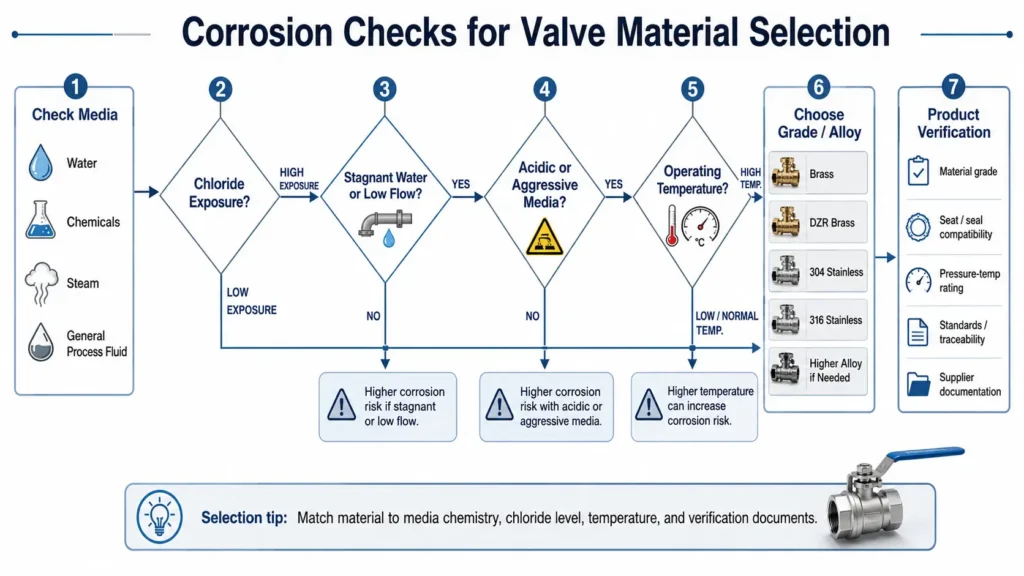
For U.S. drinking-water plumbing products, EPA describes “lead free” rules by weighted average across wetted surfaces and notes certification needs for regulated plumbing products. As a result, do not assume potable-water or lead-free status from the material name alone.
Body Material Is Only One Part of Valve Selection
Also, do not stop at body material. A valve also has seats, seals, a stem, end connections, ratings, and sometimes an actuator. Each part can affect the final choice.
Before you choose between brass and stainless steel, review the complete valve package:
| Valve item | Why it matters | What to check |
|---|---|---|
| Body material | This article focuses on the body material. | Brass alloy or stainless steel grade, product data, and service conditions. |
| Seat material | The seat affects sealing and service fit. | Media, temperature, wear, and supplier guidance. |
| Seal material | The seal can limit temperature, chemical exposure, and sealing performance. | Seal material, media, temperature, and maintenance needs. |
| Stem and trim | Internal parts may contact the media and carry mechanical load. | Material match, corrosion risk, and design data. |
| End connection | The connection affects installation and system integrity. | Threaded, flanged, welded, tube fitting, or other connection type. |
| Actuator or handle | The operation method affects control needs. | Manual, pneumatic, electric, or other actuation needs. |
| Rating | The rating helps confirm service fit. | Pressure, temperature, and the lowest-rated component. |
| Media | The media drives material review. | Fluid or gas type, concentration, contaminants, pH, temperature, and flow conditions. |
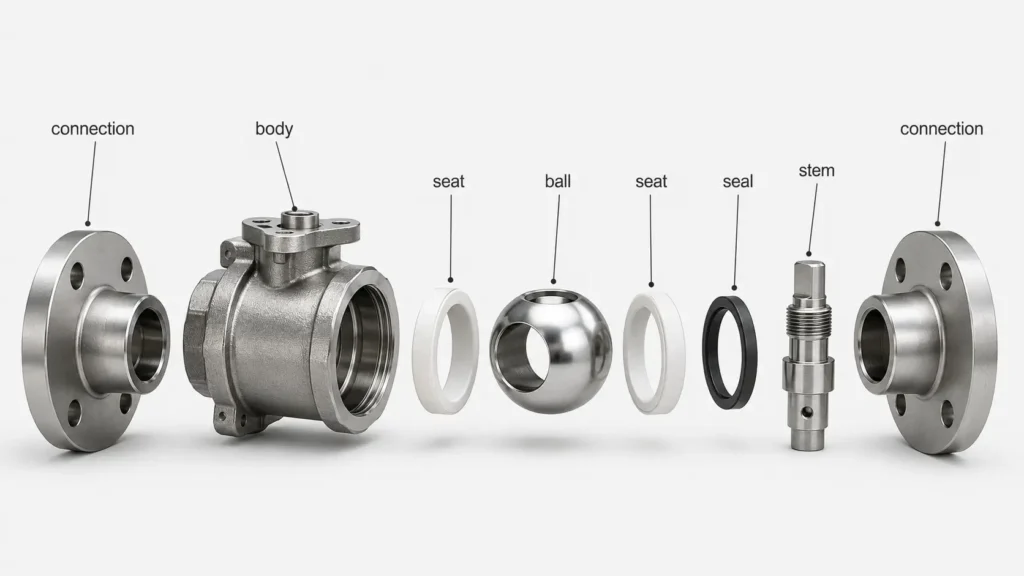
Swagelok’s valve-selection guidance uses the STAMPED method: size, temperature, application, media, pressure, ends or fittings, and delivery. It also notes that the lowest-rated component can affect pressure limits and that pressure and temperature interact.
Therefore, do not choose a valve by asking only, “Is brass or stainless steel stronger?” Instead, ask whether the full valve assembly fits the actual service. For broader product navigation, see XHVAL’s ball valve category and the ball valve actuator guide.
How to Choose Between Brass and Stainless Steel for Your Application
Next, use these checks before RFQ or engineering review. They do not replace product datasheets, supplier confirmation, or project-specific compliance checks.
Step 1: Check the service conditions
First, define what the valve will carry and where it will operate. Then compare both materials against those conditions.
| Condition to review | Why it matters | Brass review note | Stainless steel review note | RFQ detail to confirm |
|---|---|---|---|---|
| Media | The process fluid or gas affects material fit and corrosion risk. | Review brass only when the alloy and complete valve fit the media. | Review stainless grade and component fit for the media. | Media name, concentration, contaminants, and state. |
| Corrosion exposure | Corrosion can affect service life and safety. | Check for dezincification or corrosion risk in specific water or chemical conditions. | Check for localized corrosion risk, especially with chlorides, acids, or crevices. | Water chemistry, chloride level, pH, cleaning process, outdoor or marine exposure. |
| Pressure | Body material alone does not define pressure fit. | Confirm product rating and the lowest-rated component. | Confirm product rating and the lowest-rated component. | Working pressure, design pressure, and pressure cycles. |
| Temperature | Temperature can affect seals, seats, metal parts, and ratings. | Confirm the full valve temperature range. | Confirm the full valve temperature range. | Media temperature, ambient temperature, and fluctuation. |
Step 2: Check valve design and documents
Next, review the full valve package. Also, list the documents the project needs before the supplier prepares a quote.
| Condition to review | Why it matters | Brass review note | Stainless steel review note | RFQ detail to confirm |
|---|---|---|---|---|
| Valve type | Different valves serve different functions. | Confirm whether the valve handles on/off, isolation, control, or another function. | Same; material does not replace the correct valve type. | Ball, gate, globe, check, butterfly, plug, or other type. |
| End connection | The connection affects installation and system needs. | Confirm threaded, flanged, welded, or other connection. | Same. | Connection type, size, standard, and installation limits. |
| Seats and seals | Soft materials can limit service conditions. | Confirm seat and seal material, not only body material. | Same. | Seat material, seal material, media, and temperature. |
| Documentation | Some projects require certificates or compliance documents. | Do not assume documents or standards. | Do not assume documents or standards. | Required documents, inspections, material declarations, or certifications. |
| Budget | Purchase cost is only one part of selection. | Review budget only with service conditions and product data. | Review project risk, document needs, and service conditions. | Budget range, quantity, project risk, and service expectations. |
Finally, avoid final rules such as “choose brass for X” or “choose stainless steel for Y.” The real decision depends on the product, grade or alloy, valve design, and service conditions.
RFQ Checklist Before Choosing Brass or Stainless Steel
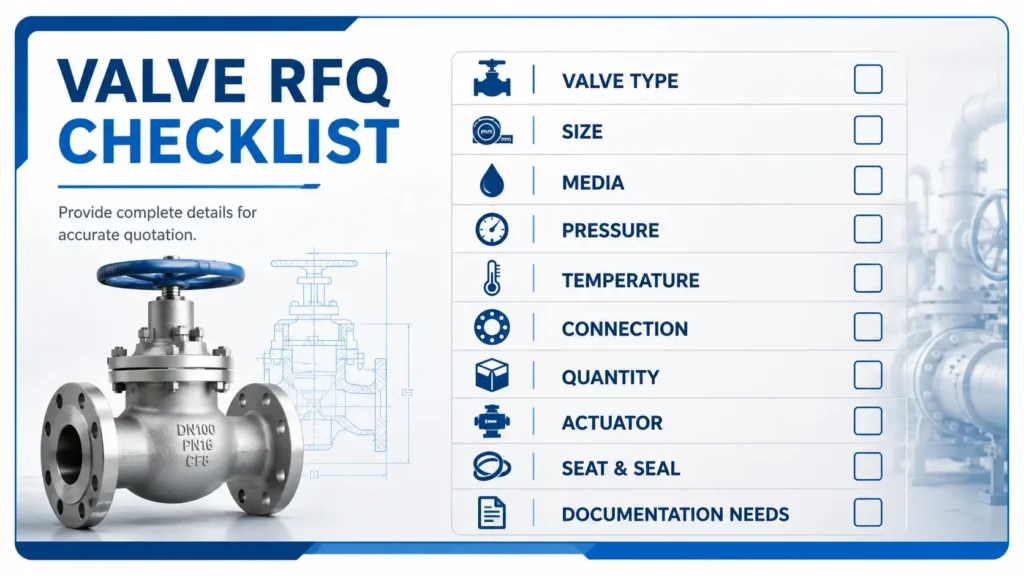
Before you ask for a quote, prepare enough information for material review. A clear RFQ reduces guesswork and helps the supplier avoid unsafe assumptions.
| RFQ detail | What to provide |
|---|---|
| Valve type | Ball, gate, globe, check, butterfly, plug, strainer, or other valve type. |
| Valve size | Nominal size, bore need, or drawing reference if available. |
| Media | Fluid or gas, concentration, contaminants, water chemistry, pH, or other key details. |
| Pressure | Working pressure, design pressure, pressure cycles, and any test need. |
| Temperature | Operating temperature, ambient temperature, and temperature changes. |
| Connection type | Threaded, flanged, welded, tube fitting, or other required connection. |
| Quantity | Prototype, small batch, project batch, or repeat-order estimate. |
| Body material preference | Brass, stainless steel, or open material review. |
| Seat and seal needs | Known seat/seal material preference or media and temperature limits. |
| Actuator needs | Manual, pneumatic, electric, or other actuation need. |
| Document needs | Datasheets, drawings, material documents, inspection needs, or compliance documents. |
Also, do not treat an RFQ checklist as a promise that every document, certification, or rating exists. Instead, use it to help the supplier understand the application.
FAQs About Brass vs Stainless Steel
Which is better for valves: brass or stainless steel?
In short, neither is always better. Compare brass and stainless steel by media, corrosion risk, pressure, temperature, valve type, connection, seat and seal materials, budget, and document needs. If the service conditions are clear and the product data supports the application, brass may work. However, if corrosion risk, demanding service, or document needs carry more weight, review stainless steel more closely.
Is brass or stainless steel better quality?
However, “better quality” is not the right question by itself. Instead, check the alloy or grade, valve design, manufacturing control, rating, seat and seal choice, inspection needs, and fit for the application. A well-specified brass valve can fit one project, while a stainless steel valve may fit another.
What are the disadvantages of using brass?
First, remember this caution: brass does not fit every environment. Brass properties vary by alloy, and some brass alloys can face corrosion issues such as dezincification in specific water conditions. Also, do not assume drinking-water suitability, lead-free status, pressure rating, or chemical fit. Confirm the alloy, product data, media, and required documents before choosing.
Does brass rust or corrode faster than stainless steel?
In short, brass does not rust like iron or carbon steel, but it can corrode. Stainless steel resists corrosion because of its passive chromium-rich surface film. However, certain conditions can still cause localized corrosion. Therefore, ask which material and grade fit the media, water chemistry, chloride exposure, temperature, and valve design.
What lasts longer, brass or stainless steel?
Also, no safe universal lifespan answer exists. Service life depends on media, corrosion risk, pressure, temperature, valve design, grade or alloy, seats, seals, maintenance, and installation. Stainless steel may suit some demanding corrosion conditions. Still, it is not corrosion-proof. Brass may fit suitable service conditions, but it also needs alloy and application review.
Is brass or stainless steel better for water applications?
Finally, water applications need product-level review. The answer depends on water chemistry, temperature, flow or stagnation conditions, local rules, and product-specific documents. Therefore, do not assume any brass or stainless steel valve fits drinking-water use unless exact documentation and certification support that use. For regulated drinking-water plumbing products, verify lead-free and compliance status at the product level.
Need Help Reviewing Valve Material Requirements?
Choosing between brass and stainless steel gets easier when the operating details are clear. Before you request a quote, prepare the valve type, size, media, pressure, temperature, connection type, quantity, body material preference, seat/seal needs, actuator needs, and document needs.
Then share those details with XHVAL so the project discussion starts with fewer assumptions.